These terms and conditions apply to the News National app (hereby referred to as "Application") for mobile devices that was created by (hereby referred to as "Service Provider") as an Ad Supported service.
Upon downloading or utilizing the Application, you are automatically agreeing to the following terms. It is strongly advised that you thoroughly read and understand these terms prior to using the Application. Unauthorized copying or modification of the Application, any part of the Application, or our trademarks is strictly prohibited. Any attempts to extract the source code, translate the Application into other languages, or create derivative versions are not permitted. All intellectual property rights remain the property of the Service Provider.
The Service Provider is dedicated to ensuring the Application is as beneficial and efficient as possible. They reserve the right to modify the Application or charge for services at any time and for any reason. Any such charges will be clearly communicated.
The Application stores and processes personal data provided by you. You are responsible for maintaining the security of your device and access to the Application. Jailbreaking or rooting your device is strongly discouraged as it may compromise security and application performance.
Third-Party Services
The Application uses third-party services that have their own Terms and Conditions. Refer to the following links:
Google Play Services
AdMob
Google Analytics for Firebase
Firebase Crashlytics
Limitations and Responsibilities
Some Application functions require an internet connection (Wi-Fi or mobile data). The Service Provider is not responsible if the Application does not function fully due to lack of access or depleted data. If using the Application outside a Wi-Fi area, you accept responsibility for any charges incurred, including roaming fees. If you are not the bill payer, it is assumed you have obtained permission.
It is your responsibility to keep your device charged. The Service Provider is not responsible if the device is unavailable due to a drained battery.
While the Service Provider strives to keep the Application updated and accurate, they rely on third-party data and do not accept liability for losses caused by reliance on Application functionality.
Updates and Termination
The Application may be updated to remain compatible with the operating system. You agree to install updates as offered. The Service Provider may discontinue the Application at any time without notice. Upon termination:
Rights and licenses granted to you will end.
You must stop using the Application and delete it from your device.
Changes to These Terms and Conditions
The Service Provider may update these Terms and Conditions periodically. Please review this page regularly. Changes will be posted on this page.
Effective Date: 2025-07-23
Contact Us
If you have questions or suggestions about the Terms and Conditions, contact the Service Provider at: 📧 info@news-national.com
We use cookies to ensure you get the best experience on our website. By continuing to use our site, you accept our use of cookies,
Privacy Policy,
and
Terms of Service.
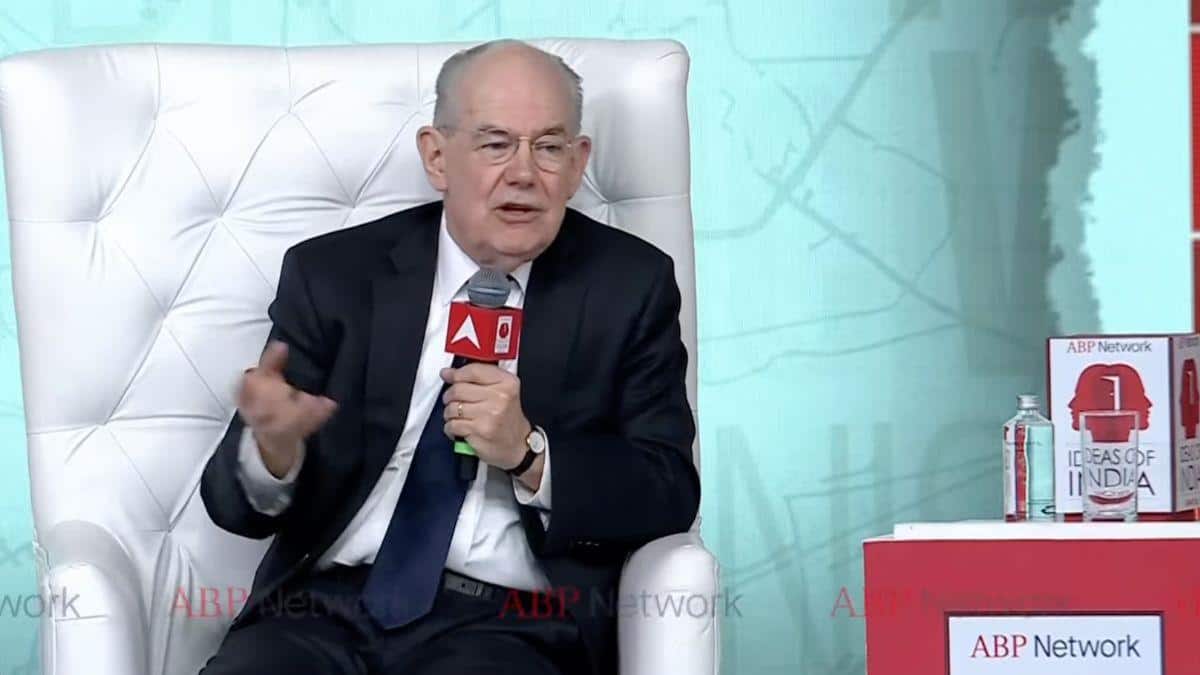
Renowned international relations scholar John Mearsheimer on Friday argued that while Washington sees New Delhi as strategically vital in balancing China, economic pressure and unpredictable leadership in the United States have created deep structural unease in the partnership.
As India positions itself at the centre of a rapidly evolving global order, questions surrounding its relationship with the United States remain both strategic and complex. At ABP Network’s flagship Ideas of India Summit 2026, Mearsheimer talked precisely about this theme, ‘US and India - A Very Rocky Relationship’, during one of the most anticipated sessions.
The session was moderated by Dr Shashi Tharoor, offering audiences a rare opportunity to witness a deep and nuanced conversation on geopolitics, power and diplomacy in real time.
President Trump Is Tariff King
Mearsheimer makes it clear that trade policy is not a peripheral issue but a core driver of friction.
"President Trump is the tariff king, he has a mercurial personality. This creates a situation where India has an incentive to not get too close to the US. You don't want to be in a position where you are dependent on the US economically because it will use that position to make you dance to its tune."
For Mearsheimer, tariffs are not merely economic tools, they are instruments of leverage. He suggests that Trump’s willingness to deploy trade pressure, even against allies, alters the calculus for countries like India.
"This is why we have a rocky relationship today between the US and India," he says, linking economic coercion directly to diplomatic distrust.
He goes further, observing that the US president often appears harsher toward partners than rivals. "Trump is tougher on our allies than he is on our adversaries," Mearsheimer remarks. "The way he treats the European allies, it is remarkable," he adds, noting that the president has "lots of instruments to facilitate that unilateralism".
In this framework, India must weigh the benefits of closer ties against the risks of economic vulnerability.
India And China In America’s Grand Strategy
Despite these tensions, Mearsheimer underscores that India occupies a central position in American strategic thinking.
"Most American policymakers believe that India is a rising great power and will in the years ahead be one of the great powers in the world," he says.
He frames Washington’s long-term objective in clear terms, "They understand that India is an important player in the American effort to contain China. The US is profoundly committed to containing China. America is a regional hegemonic power, and it is committed to remaining the same."
In his assessment, the US-China rivalry is structural and enduring. "The Chinese are pure competitors that are interested in becoming at least as powerful as the US. But for the US, India is a natural ally in the endeavour to contain China’s power in East Asia," he notes.
India, therefore, becomes both a partner and a strategic asset in Washington’s broader competition with Beijing.
The Fine Line For New Delhi
Mearsheimer cautions that India faces a delicate balancing act.
"I think India should go to great lengths not to become too dependent on the US economically and militarily," he says.
He acknowledges that powerful incentives push India towards closer alignment with Washington, particularly given shared concerns about China’s rise. However, recent developments have complicated expectations.
"The problem that India faces today is that it has powerful incentives to align closely with the US. The indians believed that they were going to have a close and positive relationship with the US up until last summer. Then Trump made some comments which were deeply antagonistic to indian people, and we are where we are today."
At the same time, he notes that over the past year, events have strengthened the argument for caution. "But at the same time, it has powerful incentives not to get too close to the US based on what has happened over the past year. My advise is to walk a fine line."
When Less US Attention May Be An Advantage
In a striking conclusion, Mearsheimer suggests that Washington’s shifting priorities may unintentionally benefit India.
"Trump has gone on to a nation-building spree in the western hemisphere. Therefore, the USA doesn't pay much attention to India nowadays. We don't have much time to focus on india and this is in the best interest of India because you don't want the US paying too much attention to you."
The remark captures the paradox at the heart of the relationship: India is viewed in Washington as essential to balancing China, yet too much American attention, especially when paired with tariff pressure and unilateral instincts, may constrain New Delhi’s strategic autonomy.
As the conversation unfolds at Ideas of India 2026, Mearsheimer’s intervention reframes the debate. The question is not whether India and the United States share interests in countering China. It is whether those shared interests can coexist with economic pressure, unpredictable leadership and competing national priorities, without pushing the partnership further into rocky terrain.
A Scholar Who Shapes Realist Thinking
John J Mearsheimer is the R Wendell Harrison Distinguished Service Professor in the Political Science Department at the University of Chicago, where he has taught since 1982. Widely regarded as one of the most influential thinkers in international relations theory, Mearsheimer is best known for his work on realism and the dynamics of great power politics.
While his career is rooted in academic scholarship, Mearsheimer actively engages in contemporary policy debates. He argues that social science theories are indispensable tools for understanding and shaping foreign policy. His analysis of global power structures, security dilemmas and shifting alliances frequently sparks intense debate in diplomatic and strategic circles.
Ideas Of India 2026: The New World Order In Focus
The fifth edition of the Ideas of India Summit takes place on February 27 and 28, 2026, in Mumbai. Hosted by ABP Network, the two-day event unfolds at a pivotal moment as India moves closer to the centenary of its independence in 2047.
This year’s theme, ‘The New World Order’, reflects both ambition and introspection. The summit explores India’s journey towards becoming a developed nation, its Aatmanirbhar economy, economic resilience, technological transformation and cultural evolution. It also examines India’s expanding global footprint and the recalibration of international partnerships in a volatile geopolitical environment.
The event is being broadcast live across ABP Network’s websites, social media platforms and YouTube channel, extending the dialogue beyond the physical venue to audiences across India and abroad.
A Conversation At A Critical Juncture
The US-India relationship today sits at the intersection of strategic cooperation and policy friction. Defence ties deepen, trade negotiations continue, and technology partnerships expand. Yet differences persist over trade frameworks, energy policy and geopolitical alignments.
The discussion takes place at a time when global alliances are shifting, supply chains are being reconfigured, and great power competition is intensifying. For India, balancing strategic autonomy with deepening ties to Washington remains a defining foreign policy challenge.
A Broader Platform For Strategic Dialogue
Ideas of India 2026 brings together a diverse spectrum of voices from politics, business, academia and the arts. Confirmed speakers include Ashwini Vaishnaw, Piyush Goyal, Shreya Ghoshal and Maharashtra Chief Minister Devendra Fadnavis, alongside actors Ishan Khattar, Kangana Ranaut, Mrunal Thakur, Monda Singh, Vishal Jethwa, Suniel Shetty and Ahan Shetty.
Held amid global economic uncertainty and geopolitical tension, the summit serves as a platform for substantive dialogue on India’s development trajectory, sustainability commitments and strategic ambitions.