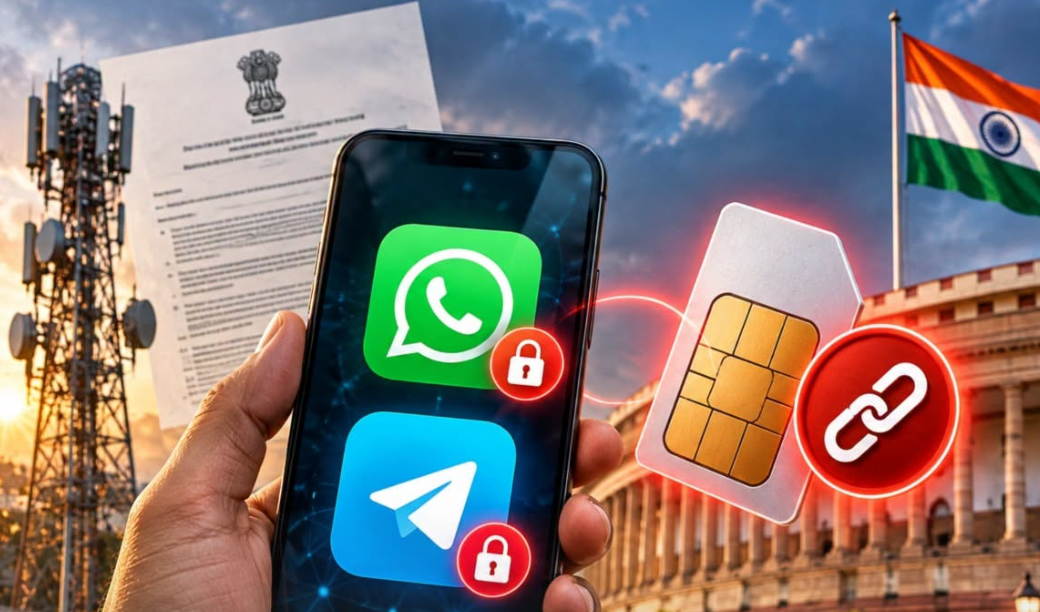
India’s SIM-binding rules target cyber fraud but may affect WhatsApp, Telegram, multi-device access and businesses from January 2027.
SIM Binding Is on the Way: What India’s New Telecom Rules Mean for WhatsApp and Telegram Users
By News National Editorial Team
India Moves Towards Mandatory SIM Binding for Messaging Apps
New Delhi: India is preparing to implement stricter SIM-binding requirements for messaging applications that use Indian mobile numbers to identify users. The Department of Telecommunications (DoT) has set 31 December 2026 as the reported compliance deadline, with the requirements expected to take effect from 1 January 2027.
The move is intended to reduce the misuse of Indian mobile numbers in cyber fraud, phishing, impersonation and so-called digital arrest scams. However, the proposed implementation has also triggered concerns about convenience, international travel, multi-device access and the operational costs faced by small businesses.
What Is SIM Binding?
SIM binding is a security mechanism that links a messaging account to the active SIM card associated with the mobile number used to register the account.
Currently, users can often register a messaging account using a mobile number and continue using it even after removing the original SIM card from their device. Companion devices and desktop sessions can also allow access without keeping the registered SIM in the device being used.
Under the proposed requirements, covered messaging services must ensure that the account remains linked to the registered, active SIM in the device running the application.
The DoT issued its original directions in November 2025 under the Telecom Cyber Security Rules, 2024, as amended. The government identified the misuse of Indian-number-based communication accounts by fraud networks operating remotely, including from outside India, as a major concern.
Which Apps Could Be Affected?
The original directions covered services including WhatsApp, Telegram, Snapchat, Signal, Arattai, ShareChat, Josh and JioChat.
The precise obligations and implementation arrangements may differ by platform. Users should therefore follow official announcements from the DoT and their messaging providers rather than assume that every application will behave identically.
The government initially also directed platforms offering web access to introduce periodic logout and QR-code relinking, with a maximum six-hour session period. Subsequent reporting in April 2026 said the government had revised its approach to web and desktop sessions towards risk-based logouts. The latest implementation details should be checked before treating the original six-hour requirement as universally applicable.
Why Is the Government Introducing These Rules?
The principal objective is to make it more difficult to operate messaging accounts using Indian mobile numbers without access to the associated SIM.
Cybercriminals may use messaging platforms to impersonate police officers or government officials, distribute fraudulent investment offers, conduct phishing campaigns or persuade victims to transfer money.
According to the government’s explanation, an account that remains active after its associated SIM is removed or deactivated can create difficulties in establishing who controls the number and how the account is being used.
SIM binding is intended to strengthen the connection between an account and its registered mobile number. However, it should not be regarded as a complete solution to cybercrime. Fraud involving stolen credentials, malicious applications, social engineering or compromised devices may continue even when SIM-binding controls are in place.
Journalist’s Analysis: Security Versus Everyday Convenience
From a public-interest journalism perspective, the central question is how effectively SIM binding can reduce fraud without unnecessarily restricting legitimate communication.
1. A possible security benefit
Requiring the associated SIM to remain present may make certain forms of remote account misuse more difficult. It can also introduce an additional obstacle for criminals attempting to operate accounts without continued access to the registered number.
2. Challenges for users with multiple devices
Many people use messaging services on a primary smartphone, a second phone, a tablet or a computer. If implementation restricts account operation on devices without the registered SIM, some existing arrangements may need to change.
This could affect journalists, freelancers, customer-support teams and other professionals who rely on desktop messaging to manage their daily work.
3. Difficulties during international travel
Indians travelling abroad may depend on Wi-Fi, a local SIM card or another device to stay connected. Users who cannot keep their registered Indian SIM active may face additional verification or access problems, depending on how each platform implements the requirements.
4. Concerns for small businesses
Small businesses frequently use messaging applications for customer enquiries, order updates, bookings and employee coordination. Restrictions on companion devices or changes to authentication procedures could increase administrative work and operating costs.
5. Questions about effectiveness and proportionality
Consumer advocates and technology-policy researchers have questioned whether mandatory SIM binding will substantially reduce fraud when many scams rely on deception, stolen passwords, malware or the misuse of legitimately registered SIM cards.
These concerns do not eliminate the need for stronger cybersecurity. They highlight the importance of evaluating whether the measures address the specific risks they are intended to prevent.
What Should WhatsApp and Telegram Users Do?
Until their respective platforms publish detailed implementation instructions, users can take a few practical precautions:
-
Keep the mobile number associated with the account active and under their control.
-
Avoid removing or deactivating the registered SIM without checking the platform’s account requirements.
-
Review linked devices and log out of sessions they do not recognise.
-
Enable available two-step verification and account-security features.
-
Never share OTPs or verification codes with callers claiming to represent the police, a bank or a government agency.
-
Before travelling abroad or changing phones, check the platform’s official guidance on SIM access and account recovery.
Users should also remember that the presence of a registered SIM does not guarantee that an account is safe from every type of cyberattack.
Conclusion
India’s SIM-binding initiative represents an attempt to strengthen telecom-related cybersecurity by connecting messaging accounts more closely to registered mobile numbers. Its real-world impact will depend on how the requirements are implemented, how platforms handle legitimate multi-device use and whether the measures produce measurable reductions in fraud.
For citizens, the priority is to understand the changes and protect their accounts. For policymakers and technology companies, the challenge is to balance security, accessibility, privacy and practical usability.
News National will continue to follow official announcements and implementation updates concerning India’s telecom cybersecurity rules.
Sources and verification
-
Department of Telecommunications / Press Information Bureau: Original SIM-binding directions, published 1 December 2025.
-
Business Standard: Reporting on the compliance deadline and expected impact, 23 October 2026.
-
The Economic Times: Reporting on the revised approach to web and desktop sessions, 1 April 2026.