

Language Settings
Select Website Language

GDPR Compliance

We use cookies to ensure you get the best experience on our website. By continuing to use our site, you accept our use of cookies, Privacy Policy, and Terms of Service.

Filters

Channels
Topics
Other Filters

Zodiac Compatibility Guide: Which Signs Naturally Click

A friendly guide to zodiac compatibility, explaining how the four elements shape which signs tend to get along and why chemistry runs deeper than sun signs. Ask anyone who dabbles in astrology whether two people are "meant to be," and the conversation usually jumps straight to sun signs. Are you a fiery Aries with a cool, watery Cancer? A steady Taurus paired with a restless Gemini? For centuries, people across cultures have looked to the stars for a shorthand on human chemistry, and zodiac compatibility remains one of astrology's most enjoyable pastimes. It is worth saying clearly up front: astrology is a tradition and a belief system, not a science. There is no proven mechanism by which distant planets dictate whether you and your best friend will bicker over dinner plans. But that has never been the point. Compatibility astrology is a playful, centuries-old language for talking about temperament, values and the friction and spark between different personalities. Read that way, it can be surprisingly useful - and a lot of fun. So which signs tend to naturally get along? The most reliable answer, according to traditional astrology, has less to do with individual signs and more to do with the four elements that group them together. The Four Elements Do the Heavy Lifting Every sign belongs to one of four elements, and this is the single most useful idea in compatibility. Fire signs are Aries, Leo and Sagittarius - bold, energetic, quick to act. Earth signs are Taurus, Virgo and Capricorn - grounded, practical, reliable. Air signs are Gemini, Libra and Aquarius - curious, social, idea-driven. Water signs are Cancer, Scorpio and Pisces - emotional, intuitive, deeply feeling. The classic rule of thumb is that signs sharing an element tend to understand one another instinctively, because they move through the world at a similar pace and prize similar things. Two earth signs value security; two air signs love a good debate. Beyond same-element pairings, tradition holds that fire and air feed each other - air "fans the flames" of fire's enthusiasm - while earth and water nourish each other, the way water helps things grow in soil. Fire and water, or earth and air, are said to need more patience to bridge the gap. Pairings Astrology Fans Reach for First Within that framework, a handful of matches come up again and again as easygoing. Leo and Sagittarius, both fire, share a zest for adventure and rarely dim each other's shine. Taurus and Virgo, both earth, build a calm, dependable partnership grounded in the everyday. Gemini and Libra, both air, can talk for hours and keep life socially bright. Cancer and Pisces, both water, tend to read each other's moods before a word is spoken. Cross-element favourites include Aries and Aquarius, where fiery drive meets airy vision, and Capricorn and Cancer - opposite signs on the zodiac wheel - who are often described as complementary, one supplying ambition and structure, the other warmth and emotional depth. Opposites, in astrology, are not necessarily incompatible; they are frequently seen as two halves that complete a whole. Where the Sparks (and Struggles) Come From Compatibility is not only about harmony. Some of the most talked-about pairings are the challenging ones, because difference creates energy. A spontaneous fire sign paired with a cautious earth sign might clash over risk, yet each can teach the other something valuable: the earth sign learns to loosen up, the fire sign learns to plan. Water and fire can misread each other - one feels flooded, the other feels dampened - but many long relationships thrive precisely because partners balance what the other lacks. The takeaway is that "getting along naturally" and "being good for each other" are not always the same thing. Effortless chemistry is lovely, but complementary differences often build the sturdiest bonds. Why Your Full Chart Matters More Here is the honest caveat that seasoned astrology enthusiasts will always add: sun signs are just the opening chapter. Your birth chart includes your moon sign, which governs emotions, your rising sign, which shapes how you come across, and the placement of Venus and Mars, traditionally linked to love and desire. Two people whose sun signs supposedly clash may share soothing moon or Venus placements that smooth everything over. That is why you might know a "mismatched" couple who are blissfully happy, and a "perfect" pairing that fizzled. The sun-sign guide is a starting point, not a verdict. How to Use This Guide Treat zodiac compatibility as a mirror for conversation, not a rulebook for your life. Use it to reflect on what you value in the people close to you - do you crave a partner who matches your pace, or one who balances it? Notice the patterns astrology describes, then check them against your real experience. The stars, in the end, are simply a way of asking better questions about how we connect. The chemistry is always yours to build. zodiac compatibility, which signs get along, astrology elements, fire earth air water signs, sun sign compatibility, astrology relationships, star sign matches

Daily Horoscope, September 09, 2026: Fresh Starts for All Signs

Your free daily horoscope for September 09, 2026. Read love, career and wellbeing predictions for Aries through Pisces and make the most of today's gentle energy. Today carries a steady, hopeful hum, inviting you to slow down and trust your instincts. Small choices ripple outward, so lead with kindness and a clear head. Whatever your sign, there is room to mend, to build and to breathe a little easier. Aries Your natural spark draws people in today, so lead conversations with warmth rather than urgency. In love, a soft word repairs more than a grand gesture ever could. At work, momentum builds when you finish one task before chasing the next. For wellbeing, channel restless energy into a brisk walk or a workout that leaves you clear-headed. Patience turns effort into progress you can feel. Taurus Comfort and consistency guide you now, and that grounded quality reassures those around you. Romantically, sharing a simple ritual deepens trust more than any surprise. Career-wise, your steady pace wins where others rush and stumble, so stay the course. Tend to your wellbeing by nourishing your body with real rest and honest meals. When you honour what you value, contentment quietly settles in. Gemini Curiosity opens surprising doors today, so follow the questions that light you up. In matters of the heart, honesty said gently clears any lingering fog between you and someone dear. Professionally, your gift for connecting ideas earns quiet admiration, so speak up in that meeting. For balance, unplug for an hour and let your busy mind rest. A single deep conversation may shift your whole outlook. Cancer Your caring instinct is a superpower, though remember to pour some of that tenderness back into yourself. Love flourishes when you let someone see your softer, unguarded side today. At work, trust your intuition on a decision that logic alone cannot settle. Support your wellbeing with familiar comforts, warm drinks and an early night. Protecting your peace is not selfish; it is how you keep giving. Leo Warmth radiates from you today, and generosity returns to you multiplied. In romance, celebrate your partner or a crush openly, for your enthusiasm is contagious. Careerwise, a moment in the spotlight arrives, so accept the credit graciously and share it too. Guard your wellbeing by resting your voice and your ambitions in equal measure. True confidence shines brightest when it lifts others alongside you. Virgo Your eye for detail makes today productive, but resist polishing what is already good enough. In love, a small practical act of care speaks louder than poetry ever could. At work, organising a messy situation earns you quiet respect and lasting trust. For wellbeing, loosen your grip on perfection and let one worry simply go. Progress, not flawlessness, is the goal worth chasing now. Libra Harmony feels within reach today, and your knack for fairness smooths a tense moment. Romantically, meeting someone halfway deepens the bond and eases old friction. In your career, a balanced perspective helps a divided team find its footing again. Nurture your wellbeing with beauty, music or a tidy corner that calms your mind. Choosing peace over being right leaves you lighter and freer. Scorpio Your focus is magnetic today, and quiet determination moves mountains others cannot budge. In love, vulnerability shared with the right person forges something unshakeable and true. At work, trust your instinct about who deserves your energy and who does not. Support your wellbeing by releasing a grudge that has quietly weighed you down. Letting go is not surrender; it is reclaiming your own power. Sagittarius Adventure calls, and even a small change of scene refreshes your restless spirit today. Romantically, spontaneity rekindles a spark, so suggest something unplanned and see who smiles. In your career, an optimistic pitch lands well, so aim a little higher than usual. For wellbeing, move your body and feed your mind something new and inspiring. Freedom feels sweetest when you carry your loved ones along. Capricorn Your discipline pays off today, and a long-term effort finally shows real results. In love, showing up reliably means more to your partner than any dramatic promise. Careerwise, a leadership moment suits you, so step forward with quiet, earned assurance. Tend your wellbeing by scheduling rest as firmly as you schedule work. Ambition is admirable, but you deserve to enjoy the summit too. Aquarius Original ideas flow freely today, and your unique view sparks something worthwhile. In romance, honesty about your needs invites a refreshingly real connection. At work, an unconventional solution impresses the very people you least expected to reach. For wellbeing, balance screen time with genuine human contact and fresh air. Your independence is a strength, yet letting someone close changes nothing about who you are. Pisces Your imagination and empathy run deep today, guiding you toward the right words and gestures. In love, a tender moment of understanding heals more than you realise. Careerwise, trust the creative hunch that others might dismiss too quickly. Support your wellbeing with quiet, art or a slow walk near water if you can. Dreaming is fine, but one small step turns your vision into something real. daily horoscope, horoscope September 9 2026, zodiac signs today, love horoscope, career horoscope, astrology prediction, today's horoscope, wellbeing forecast

Tesla Cybercab's Hidden Virtual Joystick Surprises Austin Riders

Days after launching in Austin, Tesla Cybercab riders found a secret on-screen joystick with forward, reverse, stop and horn controls in a wheel-free robotaxi. Tesla built the Cybercab with no steering wheel and no pedals - a robotaxi meant to prove manual driving is a relic. Then, less than a week after its Austin launch, riders found a hidden way to take the wheel that never was. A Taxi Without A Wheel The Tesla Cybercab is defined by what it lacks: no steering wheel, no pedals, no obvious way for a human to drive it. Officially launched in Austin, Texas, it was designed as a fully autonomous vehicle - manual control was supposed to be impossible by design. Hidden Controls Found In Days Less than a week after the Austin launch, riders discovered the Cybercab's secret manual controls. At least two videos posted on X show passengers encountering a virtual joystick on the central display, apparently meant only for Tesla employees rather than paying customers. Forward, Reverse, Stop, Horn A square screen appears in the lower left corner of the display, with a toggle in the middle for manual driving: "forward" at the top, "reverse" at the bottom. Extra buttons let a user stop the vehicle, sound the horn, and manually open the Cybercab's doors. A Frozen Supercharger On Screen To the right of the joystick sit live camera views of the vehicle's surroundings. In one rider's video, though, the image was frozen - stuck on a Tesla Supercharger from a previous location, hinting the controls surfaced as an early software bug. Built To Nudge Parked Cars The contols appear intended for Tesla employees and depot workers who need to nudge a Cybercab into a tight space at low speeds or rearrange vehicles in a lot. It spares them from calling Tesla's control center or summoning a remote operator. Police Briefed, Riders Locked Out Tesla has briefed Austin's police department on the Cybercab service, and the joystick could theoretically help responders move a stalled car. The customers who found it tried to steer - unsuccessfully. The controls didn't work, likely an early glitch Tesla will patch before wider release. Tesla Cybercab, virtual joystick, Austin robotaxi, manual controls, autonomous vehicle, Tesla Supercharger, self-driving car

Public Barely Objects To AI Replacing SEOs Harvard Study

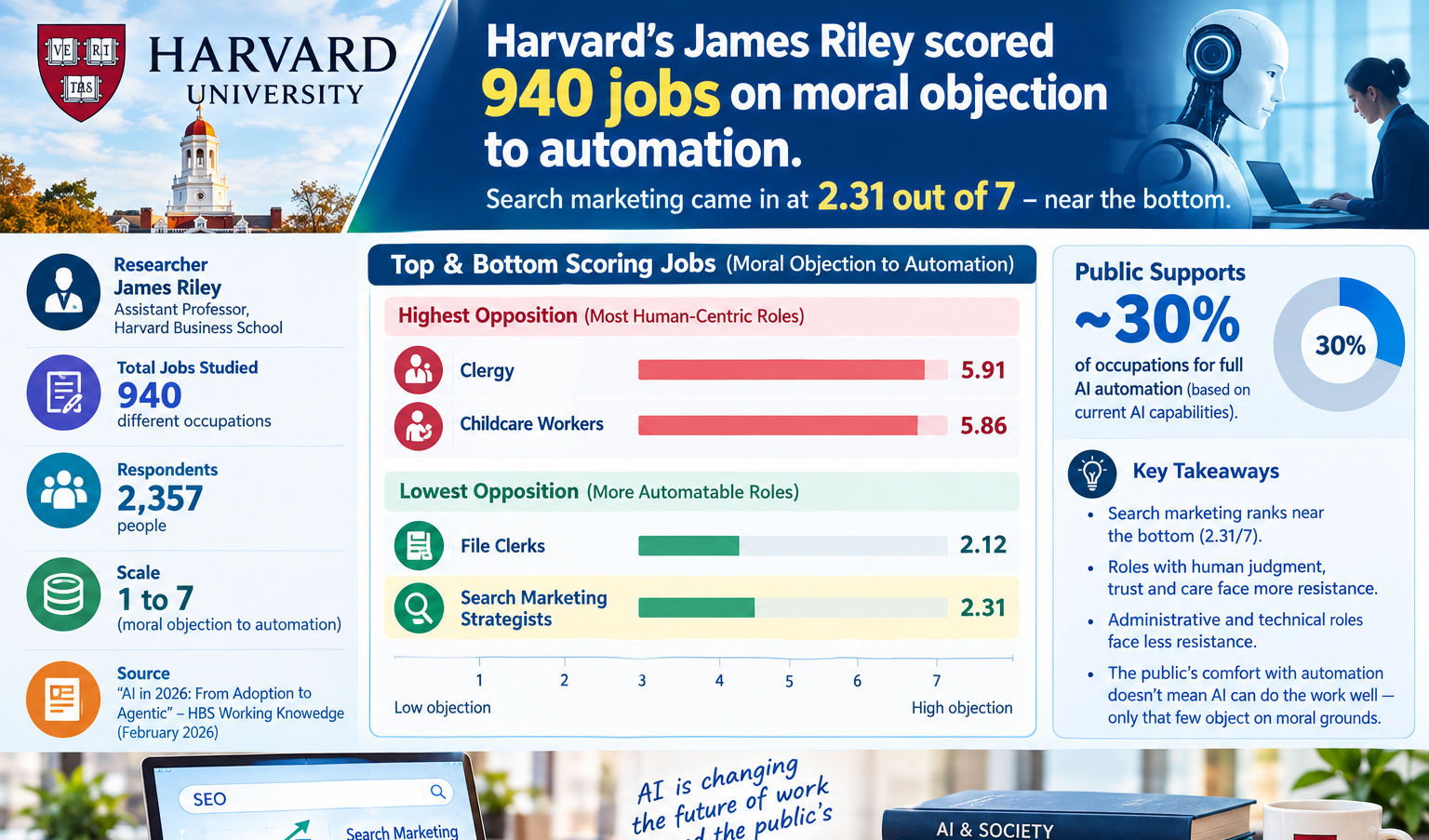
Harvard's James Riley scored 940 jobs on moral objection to automation. Search marketing came in at 2.31 out of 7 - near the bottom. Search marketing strategists rank near the bottom of a Harvard survey measuring how much the American public objects to handing jobs over to machines. On a scale of 1 to 7, respondents scored the moral objection to automating search marketing at just 2.31 - a signal that the public has little concern about artificial intelligence taking over the work. The figure comes from research by Assistant Professor James Riley, who asked the public to score 940 different occupations on how morally objectionable it would be to automate each one. Of the 10 occupations Harvard charted, only file clerks scored lower than search marketing strategists. At the opposite end sat clergy at 5.91 and childcare workers at 5.86 - roles the public strongly resists handing to machines. Riley's survey drew on 2,357 respondents across the 940 jobs. The 2.31 score for search marketing is only part of what he found. Based on AI's current capabilities, the public supports fully automating roughly 30% of the occupations he tested. The research appears in "AI in 2026: From Adoption to Agentic," a February 2026 roundup published by HBS Working Knowledge. The collection bundles five previously published pieces. Two of them report on original experiments, and those carry the main findings. The first, titled "People Are Mostly OK With AI Taking Over Many Jobs - Up to a Point," draws on Riley's October 2025 study and its occupation-scoring survey. The second, "Who Should Approve Bank Loans: People or Algorithms?", references work by Assistant Professor Elisabeth Paulson, co-authored with Kirk Bansak in 2024. The numbers cut against a common assumption inside the industry: that search marketing enjoys some protected status because the public cares whether a human or a machine does the work. The Harvard data does not support that idea. Whatever stands between these jobs and full automation, it is not the public's conscience. The scores also show how the public draws lines. Roles built on human judgment, trust and care - clergy, childcare - sit high on the objection scale. Administrative and technical roles that the public sees as rules-based, including file clerks and search marketers, sit low. The closer a job looks to a repeatable process, the less resistance there is to automating it. For those working in search marketing, the finding reframes the question. The public's comfort with automation says nothing about whether AI can actually do the work well. It says only that few people would object on moral grounds if it did. That distinction matters for how practitioners position their value and how they publish content going forward. Harvard AI study, search marketing automation, James Riley, AI job automation, SEO jobs AI, HBS Working Knowledge, moral objection automation, AI in 2026

Families Endure Months, Years of Waiting for a Dementia Diagnosis

Over a thousand UK families told the Alzheimer's Society they waited months or years for a dementia diagnosis. The charity wants an 18-week national standard. Hundreds of families across the UK have gone months, and in some cases years, without a firm dementia diagnosis for a relative, according to survey findings gathered for the Alzheimer's Society. More than a thousand people caring for someone with dementia took part, and close to half reported waiting longer than six months for an accurate answer after their first appointment with a GP. The charity is pressing for a fixed national target: a confirmed and accurate diagnosis within 18 weeks of a patient being seen and referred by their family doctor. That timeframe would bring dementia into line with the guarantees already attached to other serious illnesses, cancer among them. The survey also captured the wider cost of these delays. Respondents linked the waiting to strain on their jobs, their household finances and their own mental wellbeing. For many, the uncertainty stretched on while the condition kept advancing. Michael Fethon knows that pattern well. His father, Jim, went 18 months from the family's first GP visit to a confirmed diagnosis. Jim was eventually found to have Alzheimer's disease at 69, in 2022. During the long wait, Michael gave up his own job to look after him. "I think my dad felt beside himself because he was experiencing symptoms. It wasn't just memory loss," Michael said. Over that year and a half, Jim lost the ability to drive and to shop, and in time struggled even to walk. His son believes an earlier answer would have changed the trajectory. "If we'd have had a diagnosis sooner, he could have started medication sooner," he said, noting that although the drugs do not cure the disease, they can slow its progress and blunt its severity. Keith and Sue Andrews faced a similar limbo. The couple met at 15 and have been married since 1969 - 57 years together. Sue's condition has since worsened to the point where she lives in a care home. Keith says confirming her diagnosis took almost a year, and the not-knowing was punishing. "I won't say it's easy, but you know where you're going, and you know where you're heading and you feel a lot more confident in what you're doing," he said. "Before that diagnosis, you don't know if you're doing the right thing or what to do even. And it's a horrible time, a horrible time." That sense of relief once answers arrive was widely shared. Nine in ten families in the survey said a formal diagnosis made at least one part of their situation easier to manage. Those benefits ranged from making sense of symptoms and behaviour, to supporting the person with dementia, to reaching information and holding conversations with healthcare staff. Michelle Dyson CB, of the Alzheimer's Society, said a confirmed diagnosis unlocks support and gives families a chance to prepare. "Too many families spend months, and sometimes years, waiting for answers while their dementia progresses," she said. "It is like trying to plan a journey without knowing where you are going or when you will arrive." She drew a pointed comparison: "You would never accept someone being diagnosed with cancer and then left to work out the next steps on their own." Dementia, she added, does not wait, and neither should its diagnosis. The Department of Health and Social Care said it was committed to reinforcing the help available to people affected by dementia. dementia diagnosis, Alzheimer's Society, dementia waiting times, Alzheimer's disease, dementia care, 18-week standard, NHS dementia, carer support

Monty Don to Step Down From Gardeners' World After 20 Years

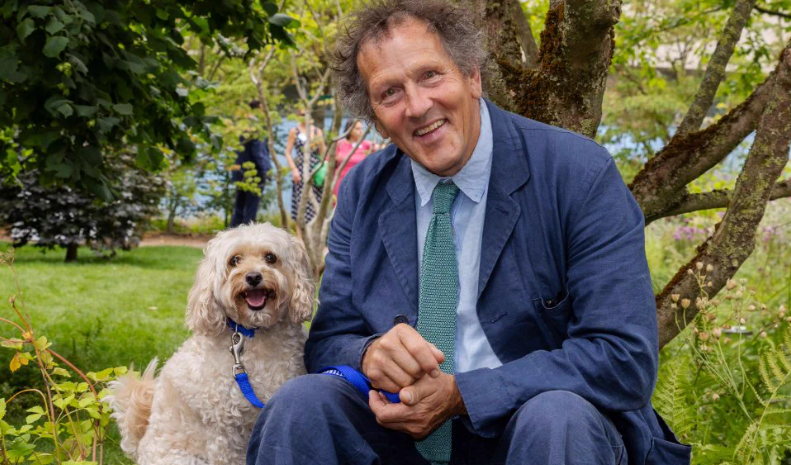
Monty Don, 71, will leave BBC's Gardeners' World at the end of the current series after more than two decades and roughly 700 episodes as head gardener. Monty Don will leave his role as the host of BBC's Gardeners' World after more than two decades, the broadcaster confirmed on 8 September 2026. The 71-year-old, the longest-serving head gardener in the show's history, will bow out when the current series ends. Don, whose full name is George Montague Don, said presenting the programme had been a "deeply rewarding experience" but that the moment had come to move on. "Now is the right time for a change," he said in a statement. He first appeared on the show in 2003, taking over from Alan Titchmarsh. Over his tenure he fronted around 700 episodes. Don began at Berryfields, a rented plot in Stratford-upon-Avon, before the show relocated in 2011 to his own garden, Longmeadow, in Herefordshire. He reflected on the bond built with viewers over those years, describing an audience he called both passionate and often deeply knowledgeable. "That connection with millions, not just in Britain but across the world, who share a love of gardens, plants and the natural world is something I have always treasured and which I increasingly believe to be at the heart of a life well lived," he said. Don praised the production side of the job, saying he had "always relished the craft of programme making," and thanked what he called the "superlative BBC team" he had worked alongside. He signalled he was not leaving the broadcaster entirely, adding that he looked forward to further projects with the BBC and to exploring "new avenues." He also made clear his own gardening would continue: "I will still be gardening, dog by side, here at Longmeadow." From This Morning to Gardeners' World Don's television career began in 1989 with a gardening slot on ITV's This Morning. That early appearance led to assignments across the BBC and Channel 4, a regular newspaper column, and a substantial body of writing - he has authored more than 20 books on gardening. His run on Gardeners' World was interrupted in 2008, when he stepped away to recover from a stroke before returning to the show. Beyond the flagship programme, he has presented a range of other titles, including Around the World in 80 Gardens, My Dream Farm, Mastercrafts and Monty Don's Rhineland Gardens. He has also anchored the BBC's coverage of the Chelsea Flower Show. BBC pays tribute The BBC said Don had "inspired and guided millions of viewers with his warmth, wisdom and passion for gardening" across his time on the show. Kate Phillips, the corporation's chief content officer, called him "unique" and described him as "a wonderfully engaging broadcaster with a soothing, calm presence who has inspired so many." Phillips said she accepted his choice while regretting it. "Monty's decision to leave Gardeners' World is one I respect, but I'm still very sad he's leaving," she said. She credited his advice with lifting the skills of viewers across the country, joking that his guidance had raised both her knowledge and her "plant survival rate." She also singled out his candour about difficult periods in his life. Phillips thanked him "for his honesty and kindness which has seen him open up about his own personal struggles and the power of the natural world to improve mental health," and said the show would miss him "hugely." Don has spoken publicly over the years about living with depression. His departure closes a chapter that spanned two gardens, hundreds of episodes and an audience that reached well beyond the UK. For now, the BBC has not named a successor, and Don's final appearances will air as the current series runs its course. Monty Don, Gardeners' World, BBC, Longmeadow, Alan Titchmarsh, Kate Phillips, gardening television, Chelsea Flower Show

Galaxy Robot Park Opens Near Seoul With Dancing Humanoids

Galaxy Robot Park, a 16,500-square-metre venue near Seoul, has opened with humanoid robots dancing to K-pop hits as its main draw. A new theme park built around robots has opened near Seoul in South Korea. Called Galaxy Robot Park, the 16,500-square-metre venue puts artificial intelligence and robotics at the centre of the visitor experience, with attractions that include humanoid robots dancing to K-pop hits. The company behind the park says its aim is to bring AI and robotics into the world of entertainment. Rather than treating the technology as a side exhibit, the venue makes machines the main event, staging performances and displays designed to showcase what humanoid robots can now do. The project reflects South Korea's wider push into robotics, and it arrives as humanoid machines take on increasingly public-facing roles. It also raises a practical question for its operators: whether robots can keep drawing visitors back once the novelty of seeing a machine dance has worn off. For now, the K-pop routines are the headline draw, tying the park's high-tech ambitions to one of South Korea's best-known cultural exports. Whether that combination can sustain repeat visits will determine if a robot-led attraction can compete with traditional theme parks over the long term. Galaxy Robot Park, South Korea robots, humanoid robots, theme park, K-pop dancing robots, artificial intelligence entertainment, Seoul attractions, robotics

6 Americans Reach 2026 US Open Quarterfinals, Most Since 2002

Six American singles players have advanced to the 2026 US Open quarterfinals in Flushing Meadows, the country's strongest showing at the tournament since 2002. Six American tennis players have advanced to the singles quarterfinals at the 2026 U.S. Open, the largest home contingent to reach that stage of the tournament since 2002. The run unfolded at the USTA Billie Jean King National Tennis Center in Flushing Meadows, New York, where the year's final Grand Slam is being played. Three of the six are women: Coco Gauff, Jessica Pegula and Emma Navarro. Their quarterfinal matches were scheduled across Tuesday and Wednesday. The last time American players filled so many quarterfinal spots at the tournament was 24 years ago, in 2002. Reaching six berths across the men's and women's singles draws marks a rare depth of results for the host nation at its own major. Gauff, Pegula and Navarro carried the American charge on the women's side into the second week in New York. Each secured a place in the last eight, keeping a domestic presence alive in the closing rounds of the singles competition. The 2026 edition continues at Flushing Meadows, with the quarterfinal round setting the field for the semifinals and the championship matches to follow. 2026 US Open, US Open quarterfinals, Coco Gauff, Jessica Pegula, Emma Navarro, American tennis, Flushing Meadows, US Open schedule

Rajpal Yadav Faces ₹5 Crore Condition Or Jail Risk

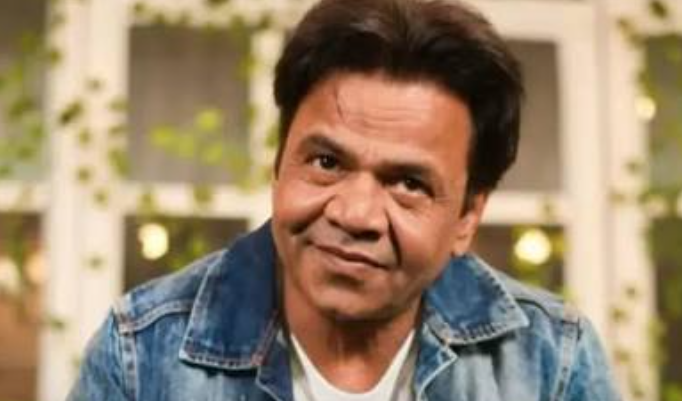
Rajpal Yadav faces a ₹5 crore condition; failing to deposit the sum could send him to jail, per AajTak coverage now trending across India. The name Rajpal Yadav is climbing India's search charts after a report that he faces a steep financial condition - and a possible jail term if he fails to meet it. Here is what the coverage actually says, and where the story stands right now. A ₹5 Crore Condition At the centre of the story is a single hard number: ₹5 crore. According to the report, that is the sum tied to Rajpal Yadav as a condition he is required to meet. It is a substantial figure by any measure, and it forms the core of the coverage now drawing wide attention. Jail On The Line The stakes attached to the ₹5 crore are unambiguous. The report states plainly that if the amount is not deposited, Rajpal Yadav could end up in jail. The consequence is spelled out in the headline itself - a direct link between the unpaid sum and the threat of imprisonment. Deposit Is The Trigger What separates the two outcomes is the act of depositing the money. The condition hinges on that deposit: meet it, and the jail scenario recedes; miss it, and the report says jail becomes possible. The framing places the decision and the deadline squarely on the deposit of ₹5 crore. Named In The Report The individual named throughout is Rajpal Yadav. The coverage does not attach the condition to anyone else - the ₹5 crore requirement and the jail warning are tied specifically to him. His name is the single identifier the report repeats as it lays out the condition he faces. AajTak Carried The Story The coverage is credited to AajTak, which reported that Rajpal Yadav faces the ₹5 crore condition and the risk of jail if it goes unmet. The outlet's report is the source driving the current wave of interest around his name. Trending On Google In India The story gained traction partly through search. "राजपाल यादव" surfaced on Google Trends India in the 100+ searches band, marking it as a name people were actively looking up as the ₹5 crore report circulated. That search spike is what pushed the coverage into wider view. The Sum, Restated In Rupees The figure is reported in rupees as ₹5 करोड़ - five crore. It is not framed as a fine already paid or a penalty settled, but as a condition still to be satisfied through deposit. The precise amount is the fixed point everything else in the report turns on. What The Report Leaves Open The available coverage stays narrow: the ₹5 crore condition, the deposit requirement, and the jail risk tied to Rajpal Yadav. Beyond those points, the source does not spell out further specifics. As it stands, the reported facts begin and end with that condition and its stated consequence. Rajpal Yadav, Rajpal Yadav 5 crore, Rajpal Yadav jail, AajTak, Google Trends India, court condition, deposit deadline

Philadelphia Teen's Study Finds Mozart's Melodies Least Predictable

Linus Chen-Plotkin, 18, analysed 600+ classical works for a Regeneron project and found Mozart's melodies broke patterns faster than his peers. An 18-year-old from Philadelphia analysed more than 600 classical compositions and found that Wolfgang Amadeus Mozart's melodies are harder to predict than those of Joseph Haydn, Ludwig van Beethoven and Franz Schubert. Linus Chen-Plotkin built the study for the Regeneron Science Talent Search, applying statistical tools to a question musicologists have argued over for centuries. His project, titled "Predictability and Statistical Memory in Classical Sonatas and Quartets," measured how much earlier notes in a piece influence the notes that follow. Chen-Plotkin designed three statistical tests to track what he calls a melody's "memory" - the degree to which one note depends on the notes before it. High memory means earlier phrases keep shaping what comes next, making the music more predictable. Low memory means a composer changes direction quickly, keeping listeners slightly off-balance. Chen-Plotkin ran the tests across more than 600 piano sonatas and string quartets by the four composers. Mozart's music returned shorter memory across all three tests. His melodies broke their patterns faster, making them less predictable than those of his contemporaries. The finding suggests Mozart followed classical form while repeatedly slipping something unexpected past the listener's ear. The result offers a measurable angle on a debate that has long relied on words like "genius" and "innovation" without defining them. Chen-Plotkin's tests give a way to quantify what set Mozart apart: not predictability, but a controlled unpredictability that stayed within the rules of his era. From wrestling mat to research desk Chen-Plotkin is the son of Joshua Plotkin and Alice Chen-Plotkin and a student at the Germantown Friends School in Philadelphia. He is a varsity wrestler and an advanced Mandarin student, and he is not a trained conservatory musician. Instead, he approached classical music as a dataset, treating centuries of musical tradition as raw material for mathematical analysis. He argues that quantitative methods can sharpen fields that have traditionally been studied through interpretation alone, including music theory, art history and literature. Music, however, is not foreign to him. He sings and plays blues guitar at The Twisted Tail, a bourbon bar, in his spare time. He is a former member and soloist of the Philadelphia Boys Choir & Chorale, and he holds a licence as an amateur radio operator. Applying the method to Chaucer Chen-Plotkin plans to extend the approach beyond music. He is working with a Johns Hopkins professor to analyse the grammatical rules of rhyme and metre in the medieval poetry of Geoffrey Chaucer. He intends to use the same statistical method on poems from different centuries. The underlying question stays largely the same across both projects: whether it is possible to measure what makes great work great. By turning notes and verse into data, Chen-Plotkin is testing whether the qualities long described as artistic excellence can be counted rather than only felt. Mozart, Linus Chen-Plotkin, Regeneron Science Talent Search, melody predictability, classical music study, statistical memory, Germantown Friends School, Philadelphia student

CPIM Won't Join TVK Front or Any Alliance, Says Balakrishnan

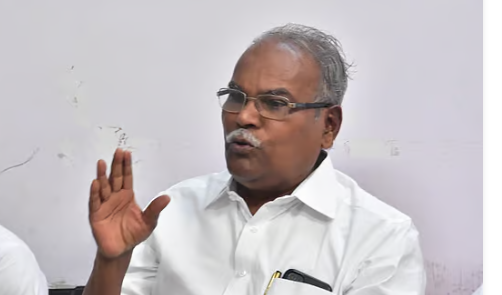
CPI(M) leader K. Balakrishnan says the party will stay out of the TVK alliance and every other front, as Left parties plan a Tiruchi rally next month. Senior Communist Party of India (Marxist) leader K. Balakrishnan has said his party will not be part of any political alliance in Tamil Nadu and will stay away from the meetings of the Tamilaga Vettri Kazhagam (TVK) front. He was speaking to reporters in Villupuram. Balakrishnan, a former state secretary of the CPI(M), said the party had taken a firm and clear decision not to join the cabinet under any circumstances. He said the CPI(M) had extended support at an earlier stage only to make sure a government could be formed, arguing that at that time no party other than the TVK was in a position to form one. Beyond that support, the party would not join the ministry or take part in events tied to the alliance, he said. Balakrishnan stated that the CPI(M) is not a member of the front and had already made clear that it would not attend its meetings. He pointed out that the party stayed away last month when the TVK alliance parties held a gathering. Balakrishnan was equally clear about the wider political map. He said the CPI(M) is not part of the DMK alliance today, nor any other alliance. Instead, the Left parties have begun to act together, and he framed this as the direction the party intends to keep following. As part of that effort, the Left parties plan a major programme next month in Tiruchi, including a large rally, Balakrishnan announced. He said the party would carry that campaign forward. On the coming by-election, Balakrishnan struck a cautious note. He said the poll had been announced only the previous day, and that the party could take a position only after internal discussions. Whether to back a candidate, whom to support, or whether to stay out altogether were all questions that would be settled through consultation in the days ahead, he said. In a separate remark, CPI(M) leader P. Shanmugam condemned the Chief Minister, describing an act of caricature or mockery attributed to him as irresponsible. CPIM, K. Balakrishnan, Tamilaga Vettri Kazhagam, TVK, Tamil Nadu politics, Left parties, Villupuram, by-election

Emma Navarro Reaches US Open Quarter-Finals, Faces Pegula Next

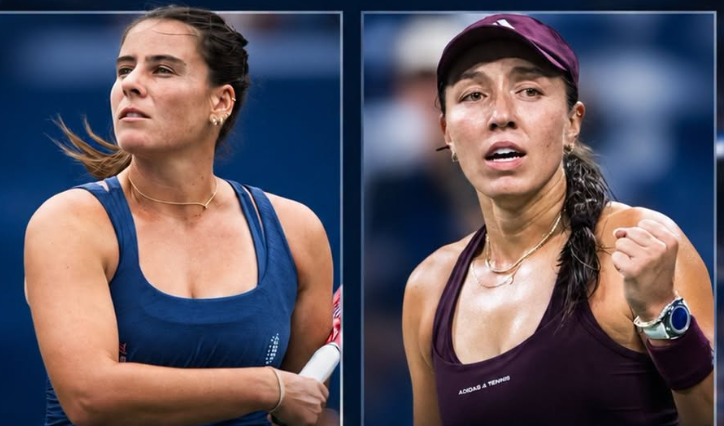
American Emma Navarro beat Anna Kalinskaya 6-4, 6-2 to reach the US Open last eight and will play compatriot Jessica Pegula next. American Emma Navarro reached the US Open quarter-finals on Sunday, beating Russia's Anna Kalinskaya 6-4, 6-2 at Arthur Ashe Stadium in New York. The 26th seed will now meet fellow American Jessica Pegula for a place in the semi-finals. Navarro, 25, came through her fourth-round match in straight sets. The win returns her to the final eight in New York, where she also advanced in 2024 before going on to reach the semi-finals that year. The run is her first at a Grand Slam quarter-final stage since the 2025 Australian Open. It follows a lengthy absence from the tour earlier this year, when she stepped away for health reasons. "It feels good to be back on Ashe," Navarro said after the match. "It's been a couple years, and I missed it a ton. I love playing out here." Her victory rounded off a strong day for American players. Ben Shelton, Jessica Pegula and Frances Tiafoe had all won earlier in front of the home crowd, setting up Navarro's all-American quarter-final against Pegula. Emma Navarro, US Open, Jessica Pegula, Anna Kalinskaya, US Open quarter-finals, Arthur Ashe Stadium, American tennis, Grand Slam tennis

Infinix Xpad 30 Pro Debuts With Helio G200, 8,200mAh Battery

Infinix Xpad 30 Pro launches globally at $196 with an 11-inch 2.5K screen, MediaTek Helio G200 Ultimate chip and an 8,200mAh battery. Infinix rolled out the Xpad 30 Pro across global markets on Tuesday, adding a mid-range Android tablet built around an 11-inch, 2.5K screen and a large 8,200mAh battery. Pricing opens at $196, or roughly Rs. 18,000, and buyers can pick from three finishes: Anthracite Grey, Twilight Purple and Titanium Silver. At the heart of the device sits MediaTek's octa-core Helio G200 Ultimate chip, matched with a Mali-G57 MC2 graphics unit. The tablet ships in four memory and storage tiers - 8GB with 256GB, 8GB with 128GB, 6GB with 128GB, and 4GB with 128GB. Onboard storage uses UFS 2.2, and owners can borrow up to 16GB of extra RAM virtually or add as much as 2TB through a microSD card. The software side runs XOS 16.3, layered over Android 16. Infinix fits the 11-inch panel with an 85 percent screen-to-body ratio, switchable 60Hz and 90Hz refresh rates, and peak brightness of 550 nits. Panda MN228 glass shields the front, and the display holds TÜV Rheinland certification for both Hardware-Level Low Blue Light and Flicker-Free output. Infinix bundles the X Pencil 20 stylus and the X KeyBoard 11 with the tablet, pushing it toward note-taking and light productivity. Imaging is handled by an 8-megapixel rear camera and a matching 8-megapixel front sensor, each with an f/2.0 aperture. Both can capture video up to 2K at 30fps. Connectivity covers 4G, Wi-Fi, Bluetooth 5.3, GPS and a USB Type-C port. The tablet carries dual speakers tuned with DTS, plus a G-sensor, e-compass, ambient light sensor and SAR sensor. The 8,200mAh cell supports 18W wired charging. Measuring 254.04x165.55x6.6mm and tipping the scales at 476g, the Xpad 30 Pro keeps a slim profile despite its sizeable battery. Infinix Xpad 30 Pro, Infinix tablet, MediaTek Helio G200 Ultimate, Android 16 tablet, 8200mAh battery tablet, Infinix Xpad 30 Pro price, 2.5K tablet, budget Android tablet

US Destroys Five Iranian Oil Tankers Near Kharg Island

US Central Command says its forces sank five Iranian crude carriers near Kharg Island and the Gulf of Oman after IRGC missile attacks on a US warship. The United States sank five Iranian oil tankers in and around the Persian Gulf on Tuesday, US Central Command said, after Iran's Islamic Revolutionary Guard Corps fired ballistic missiles at a US Navy warship twice over the preceding two days. Centcom released satellite footage dated September 8 showing the tankers being hit. Four vessels - the M/T Kaviz, M/T Charminar, M/T Horizon 1 and M/T Riesco - were struck in the Gulf of Oman, while a fifth, the M/T Derya, was destroyed close to Kharg Island. US forces ordered the crews off each ship before opening fire and said the vessels were left unusable. Washington said the tankers formed part of a multibillion-dollar "shadow network" that Tehran used to finance the IRGC and the armed groups it backs across the region. No American personnel were hurt, according to Centcom. The strikes were ordered by President Donald Trump's administration and drew an immediate response from the IRGC, led by Mojtaba Khamenei, which promised a forceful reprisal. Centcom said every Iranian attempt to hit US warships had failed. It said the targeted Navy vessel dodged both missile salvoes and stayed on patrol in the area. Tuesday's operation followed a series of earlier confrontations. Over the weekend, Iran launched ballistic missiles at a US aircraft carrier and a guided-missile destroyer, and US forces struck an Iranian tanker roughly six miles from Kharg Island. On September 5, Centcom said it had sunk three other Iranian crude carriers, action it linked to an attempted Iranian strike on the same carrier and destroyer. Separately on Tuesday, the Trump administration announced broad sanctions on Iran's aviation industry. The measures name 27 Iranian airlines along with nine service providers and sales agents accused of supporting Mahan Air. The privately held carrier has faced US sanctions since 2011 over allegations that it helps the IRGC. Centcom said Iran again tried to attack US ships on Monday, extending the run of clashes that began with the weekend missile launches against the carrier and destroyer. US Iran conflict, Kharg Island strikes, Iranian oil tankers, IRGC retaliation, Centcom, Gulf of Oman, Mahan Air sanctions, Persian Gulf

XUV 7XO, XEV 9e Lead the Way Mahindra Weighs Hybrid Futures

Mahindra is developing a full hybrid for the XUV 7XO and a range extender for the XEV 9e, but has not confirmed a hybrid Scorpio Lifestyler pickup. Mahindra is developing several electrified powertrains for its Indian SUV range, including a full hybrid for the XUV 7XO and a range-extender system for the XEV 9e, but the company has stopped short of confirming a hybrid version of its newly revealed Scorpio Lifestyler pickup. The Scorpio Lifestyler was unveiled recently with a planned launch in April 2027. Depending on the market, the pickup is expected to be offered with a 2.2-litre turbo diesel and a 2.0-litre turbo petrol engine. Mahindra has considered electrified options for the model but is not yet committing to either a hybrid or a fully electric version. Speaking to Carsales Australia, Mahindra's Head of International Operations, Sachin Arolkar, said a pure-electric powertrain is not being considered for the pickup segment. Asked whether a hybrid Lifestyler could arrive, Arolkar replied, "Just hold your horses for some time" - a response that leaves the door open without confirming anything. Diesel First for the Lifestyler In markets such as Australia, the Lifestyler could launch primarily with a diesel powertrain. Electrified pickups are gaining ground there, with the BYD Shark 6 PHEV and the Ford Ranger PHEV now on sale. Even so, diesel still accounts for a large share of the ute segment, particularly among buyers who prioritise towing, long-distance driving and heavy-duty use. For now, Mahindra appears to be taking a wait-and-watch stance on electrifying the pickup. The picture is different in India, where Mahindra is pursuing a broader powertrain strategy for its SUVs. The company already has a strong lineup of petrol and diesel models, alongside a growing born-electric range under its BE and XEV families. A strong hybrid would let Mahindra fill the gap between conventional combustion vehicles and pure EVs. A Full Hybrid for the XUV 7XO One of the key developments is a full-hybrid powertrain for the XUV 7XO, which would mark a notable expansion of Mahindra's engine options. Hybrid SUVs are becoming increasingly relevant in India, where Toyota and Maruti already hold a sizeable presence. Newer entrants are sharpening competition at the premium end, including the Kia Sorento Hybrid and the MG Hector Tomahawk PHEV. The Kia Sorento Hybrid pairs a 1.6-litre turbo petrol engine with an electric motor. The MG Hector Tomahawk has entered the market with a plug-in hybrid system. Both offer buyers an alternative to conventional petrol and diesel SUVs, and the XUV 7XO Hybrid would be Mahindra's direct answer to that growing category. A Range Extender for the XEV 9e Mahindra is also working on a range-extender, or EREV, powertrain for the XEV 9e. Unlike a conventional hybrid, in which the combustion engine can drive the wheels directly, a range-extender setup uses the engine mainly to generate electricity and stretch the vehicle's usable driving range. That approach could ease one of the main concerns of EV ownership: reliance on charging infrastructure during long trips. It would allow the XEV 9e to reach a wider set of buyers while keeping a largely electric driving experience. The system offers a different route to the same problem the XUV 7XO Hybrid targets - serving customers who want EV benefits but worry about charging on longer journeys. Taken together, the plans point to a strategy broader than a simple choice between combustion and electric. Petrol and diesel will continue to serve conventional SUV buyers, the BE and XEV models will cater to pure-EV customers, and strong hybrids and range extenders could eventually occupy the space between them. For now, that electrification push is centred on Mahindra's SUV portfolio rather than the Scorpio Lifestyler. Whether the company extends these powertrains to its ladder-frame models remains open, and Arolkar's comments suggest a decision on the pickup is still some way off. Mahindra XUV 7XO hybrid, Mahindra XEV 9e EREV, Scorpio Lifestyler, Mahindra hybrid SUV, range extender EV India, Sachin Arolkar Mahindra, electrified SUV India, Mahindra pickup Australia