

Language Settings
Select Website Language

GDPR Compliance

We use cookies to ensure you get the best experience on our website. By continuing to use our site, you accept our use of cookies, Privacy Policy, and Terms of Service.

Filters

Channels
Topics
Other Filters

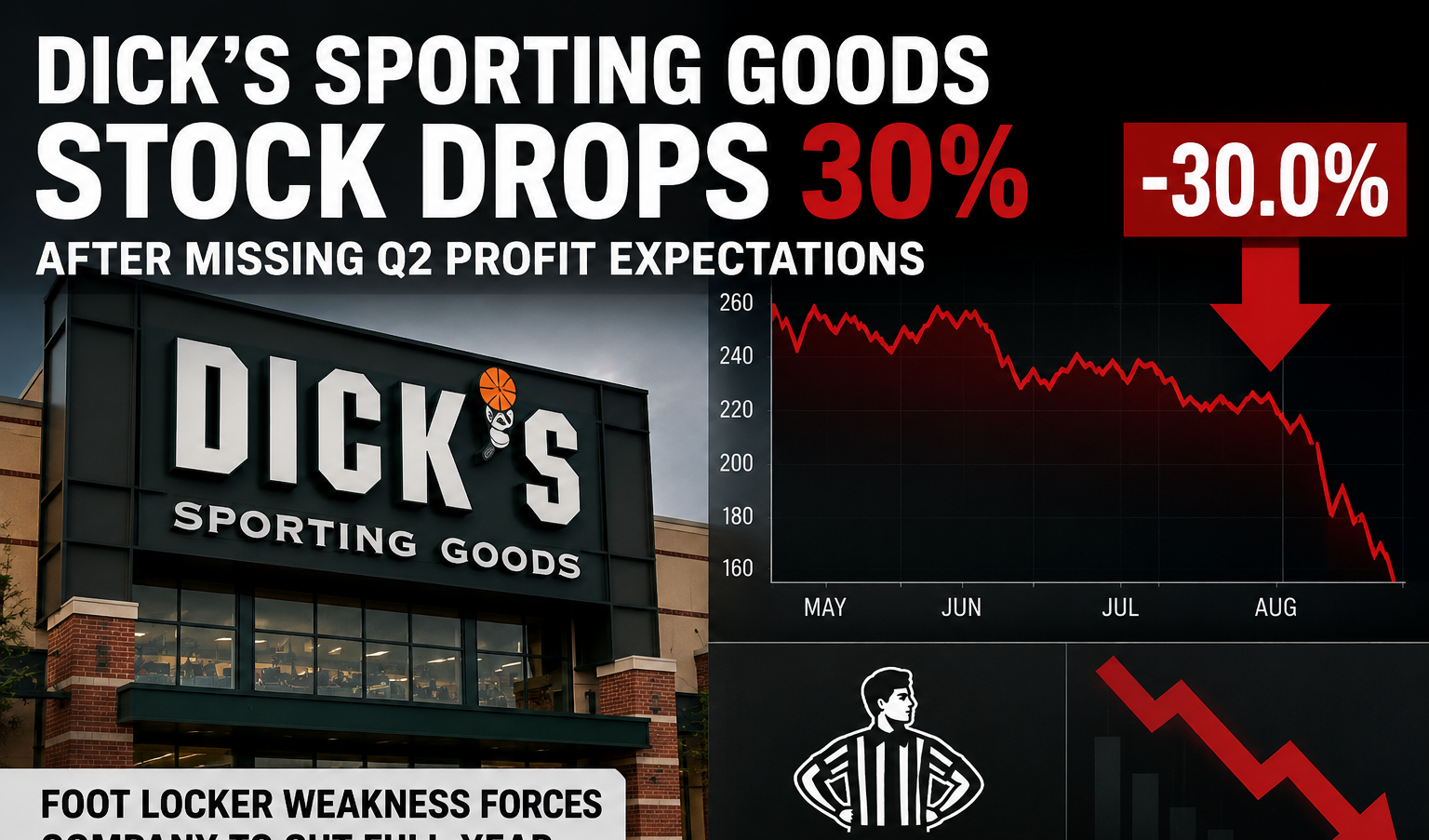
Dick's Sporting Goods Stock Falls 30% on Foot Locker Weakness

Dick's Sporting Goods stock drops 30% after missing Q2 profit expectations, with Foot Locker weakness forcing the company to cut full-year sales and earnings guidance. Retail sporting goods chain Dick's Sporting Goods experienced a sharp market correction on Tuesday as investors reacted to fiscal second-quarter results that missed Wall Street expectations. The disappointing earnings and revised outlook prompted a steep stock decline, raising questions about the company's ability to navigate near-term market challenges, particularly at its newly acquired Foot Locker subsidiary. The market's severity of response—a 30% decline in share price during Tuesday trading sessions, the steepest drop since 2023—reflects investor concerns about the company's prospects. For the quarter ended August 1, Dick's reported net income of $315 million, or $3.50 per share, down significantly from $381 million, or $4.71 per share, in the comparable period a year earlier. Adjusting for one-time items including the Foot Locker acquisition, the company earned $3.53 per share. Revenue expanded to $5.59 billion from $3.65 billion in the prior year, though this growth was largely attributable to the integration of Foot Locker's sales into consolidated results. The disparity between revenue expansion and net income decline on a per-share basis reflects margin pressures and acquisition-related costs that Dick's management must address. The company attributed operational challenges to what it described as a difficult environment across athletic footwear and apparel categories, creating headwinds for specialty retailers. Dick's Core Banner Demonstrates Market Strength The core Dick's Sporting Goods stores delivered a brighter picture than the consolidated results suggested. The business posted a 4.9% increase in comparable sales during the quarter, driven by what management characterized as broad-based growth across multiple merchandise categories. Athletic merchandise saw particularly strong performance, bolstered by consumer shopping activity connected to World Cup-related events and promotions during the period. This resilience in Dick's primary business operations contrasts sharply with weakness elsewhere in the company's portfolio. The strength suggests that the Dick's brand itself maintains consumer appeal and market positioning despite recognized difficult conditions in athletic footwear and apparel retail. Management's decision to maintain guidance for this business segment underscores confidence in its trajectory going forward. Foot Locker Acquisition Weighs on Financial Performance The principal source of disappointment in Dick's results came from Foot Locker, the footwear-specialty retailer that the company acquired for $2.4 billion in 2025. At the time of acquisition, Dick's characterized the deal as a strategic opportunity to expand its international presence and enhance competitive positioning against larger retail rivals in athletic footwear and apparel categories. The acquisition has not yet delivered anticipated benefits. Foot Locker saw comparable sales decline by 3.6% during the quarter, prompting Dick's to substantially revise its expectations for the subsidiary. The company now projects that Foot Locker will deliver flat to slightly negative comparable sales growth for the full fiscal year, a notable downward revision from prior guidance that had implied potential for expansion. This performance illustrates the challenge retailers face when attempting to integrate acquisitions during periods of sector headwinds. Successfully revitalizing an underperforming subsidiary requires not only operational improvements but also more favorable market conditions for athletic footwear and apparel retail. Guidance Cuts Reflect Heightened Caution The weakness at Foot Locker forced Dick's to trim financial guidance across major metrics. The company reduced its full-year net sales guidance to a range of $21.9 billion to $22.2 billion, narrowed from previous guidance of $22.1 billion to $22.4 billion. More significantly, consolidated operating income expectations were cut to between $1.45 billion and $1.55 billion, down from the prior range of $1.69 billion to $1.81 billion, indicating management's expectation of sustained margin challenges. The company maintained its guidance for core Dick's operations, which it still expects to grow between 2.5% and 4% in comparable sales. This distinction between maintained guidance for the legacy Dick's business and reduced overall guidance illustrates management's assessment that underlying business quality remains solid while integration and operational challenges at Foot Locker represent the primary headwind. Path Forward Amid Market Uncertainty Chief Executive Officer Lauren Hobart addressed the results by acknowledging that the company is adopting a more cautious perspective for the balance of the fiscal year, while reiterating confidence in the underlying strength of the Dick's brand and expressing long-term optimism regarding the Foot Locker opportunity. During the quarter, the company received $59 million in tariff refunds and $2.1 million in related interest income, providing some offset to operational challenges. These one-time items helped cushion quarterly results against weakness in underlying business performance. The earnings report underscores the significant work Dick's must undertake to realize value from its major acquisition and highlights the complex operating environment specialty sporting goods retailers navigate amid shifting consumer preferences and intense competitive dynamics in athletic footwear and apparel retail.    

Norwegians grieve King Harald V's death after 35 years on the throne. His son Haakon VIII assumes the crown amid national mourning.

King Harald's Death Marks End of 35-Year Norwegian Reign King Harald V of Norway has died at age 89 following a prolonged battle with a rare blood condition. The 35-year reign of the widely respected monarch came to an end Friday morning at a hospital in the capital, triggering an immediate and profound outpouring of grief across the nation. The news also prompted tributes from global leaders and members of the international royal community. His son, 53-year-old Haakon VIII, has now assumed the throne and pledged to uphold the royal family's guiding principle of "All for Norway." The announcement of Harald's passing prompted immediate gatherings at the royal palace in Oslo, where thousands of citizens began assembling to express their sorrow and pay their respects. Members of the public brought flowers, candles, and national flags to leave at the palace gates, with many visibly moved as they paid tribute to a monarch widely regarded as having brought modernization and genuine accessibility to the Norwegian crown. By Friday afternoon, an estimated 10,000 people lined the streets of Oslo as the late king's coffin was transported from the hospital to the palace in a solemn procession watched by the nation. A New Era Begins The 53-year-old Haakon VIII wasted no time stepping into his role as king. He convened an extraordinary meeting with government ministers to formally assume his leadership responsibilities, during which he publicly committed to the family motto that has guided the monarchy: "All for Norway." This early statement signaled his intention to continue the inclusive and forward-looking approach to governance that his father had championed throughout his long reign. Prime Minister Jonas Gahr Støre was among the first government officials to extend official condolences, laying flowers at the palace and adding his signature to the book of remembrance after greeting the new monarch. In a televised address to the nation, Støre reflected on the late king's impact on Norway, stating that his influence and legacy would endure in the nation's collective memory. The Prime Minister also extended heartfelt sympathy to Queen Sonja, noting that she and Harald would have celebrated their 58th wedding anniversary on the following day. Tributes From Home and Abroad Expressions of grief and remembrance poured in from across the globe, with international leaders and public figures reflecting on Harald's significance to Norway and the broader European community. Members of Europe's royal families, including King Charles III of Britain, offered their condolences and reflections on the late king's long life. Charles and Harald were connected through their shared royal heritage, part of the intricate network of European royal families bound by centuries of tradition and kinship. Within Norway itself, tributes came from all segments of society, transcending the typical boundaries of formal state ceremonies. Erling Haaland, the nation's internationally recognized footballer, took to social media to express his personal gratitude for the late king, recalling a meeting at the palace in the summer and thanking him for his profound impact on the country both within and beyond its borders. Ordinary citizens gathered in public spaces to share their memories and articulate what Harald had meant to their personal lives and their understanding of Norwegian identity. One Oslo resident who had immigrated from Ethiopia described the late king's exceptional ability to make newcomers and outsiders feel genuinely welcomed and valued. She spoke of his warm demeanor and authentic compassion toward all people regardless of their background or origin, describing him as a figure who embodied Norway's inclusive values. Ceremonies and National Mourning As the nation entered an official period of mourning, various ceremonies and rituals were conducted to honor the late king's memory. At midday Friday, the Norwegian Armed Forces performed a 21-gun salute fired from Akershus Fortress in central Oslo, a traditional military honor that resonated across the capital and served as an audible reminder of the nation's loss. Throughout the country, flags were lowered to half-mast as Norwegians engaged in collective remembrance. The palace announced that Harald's body would lie in state in the chapel at the royal residence, allowing members of the public to pay their final respects during the mourning period. Citizens gathered at landmarks and public spaces to light candles, leave written tributes, and observe moments of silence in honor of the departed monarch. The state funeral date remains to be officially announced by the royal household. A Modernizing Legacy Throughout his 35-year reign, Harald earned recognition as a king who genuinely sought to bring the monarchy closer to ordinary people. Rather than maintaining rigid distance and formality, he cultivated an image of transparency and authentic connection with his subjects. His approach redefined what it meant to be a modern European monarch—one capable of balancing deep respect for tradition with genuine relevance to contemporary Norwegian society. The transition to Haakon VIII marks a pivotal chapter in Norwegian history. With his accession and adoption of the national motto, the new king appears positioned to honor his father's legacy while establishing his own path during a time of significant change.

Alleged Chandrasekhar Letter Surfaces, Claims Property Financing for Fatehi

An alleged letter from Sukesh Chandrasekhar to Nora Fatehi reportedly discusses lavish property financing and relationship tensions with Jacqueline Fernandez. An alleged communication attributed to businessman Sukesh Chandrasekhar has emerged, purporting to detail substantial financial dealings with actress and dancer Nora Fatehi. The letter reportedly addresses matters related to expensive property arrangements and references digital exchanges concerning high-value acquisitions, reigniting discussion around the financier's interactions with entertainment industry figures. The alleged correspondence claims that Chandrasekhar financed an upscale residential property located in Morocco on behalf of Fatehi. According to reports, the letter references supposed WhatsApp conversations discussing various costly purchases, though specific details remain limited in available accounts. Property Allegations and Financial Claims At the center of the alleged letter are claims regarding the financing of a luxurious Moroccan residence. While the exact circumstances and financial details have not been independently verified, the emergence of this alleged communication adds another layer to existing discussions about Chandrasekhar's reported financial activities and personal relationships within the entertainment sphere. The letter reportedly includes references to digital communications that purportedly document conversations about significant expenditures. Such exchanges, if verified, could provide insight into the nature and scope of the alleged financial relationship between the two figures. Relationship Tensions and Accusations Beyond property-related claims, the alleged letter reportedly contains accusations directed at Fatehi regarding her feelings toward Chandrasekhar's relationship with actress Jacqueline Fernandez. The correspondence suggests tension stemming from this romantic connection, with Chandrasekhar allegedly characterizing Fatehi's emotional response as jealousy. The alleged communication further reportedly includes cautionary language, with Chandrasekhar ostensibly warning Fatehi against engaging in further provocative behavior. This element of the letter adds complexity to the narrative surrounding the three individuals and the interconnected controversies that have previously drawn media and public attention. Context of Ongoing Scrutiny These allegations surface amid broader legal and investigative scrutiny that has touched multiple entertainment industry personalities in recent years. The emergence of such personal communications—whether authentic or disputed—continues to spark debate about financial transparency, personal conduct, and accountability within celebrity circles. Chandrasekhar has previously been at the center of significant legal proceedings and investigations, while both Fernandez and Fatehi have faced their own separate controversies. The alleged letter connecting these figures represents another chapter in a narrative that has periodically captured public interest and media focus. Verification and Authenticity Questions While reports cite the alleged letter and the claims within it, questions about its authenticity, the circumstances of its emergence, and the verifiability of its contents remain open. Such communications, particularly when they surface in public discourse, often invite scrutiny regarding their origins and reliability. The broader implications of these allegations—should they prove substantiated—touch on questions concerning financial arrangements between private individuals, the nature of personal relationships, and the degree to which such matters merit public examination versus remaining private affairs. The entertainment industry continues to grapple with evolving standards of transparency and accountability, even as privacy considerations remain relevant for public figures navigating their personal and financial lives.  

Elon Musk's X platform suspended over 500,000 Indian accounts for promoting terrorism and child sexual abuse material, marking major enforcement action.

X Removes 5 Lakh Indian Accounts for Policy Violations Elon Musk's X platform has taken significant enforcement action against Indian users, removing over 5 lakh accounts that contravened its community standards. The mass suspension represents a substantial effort by the company to maintain compliance with its policies governing user behavior and content distribution across its network. The accounts were terminated due to a range of serious violations, including activities that promoted terrorism and facilitated child sexual exploitation material. These categories represent some of the most severe breaches of platform policies and carry legal implications in most jurisdictions. The action underscores the platform's commitment to addressing harmful content that poses risks to public safety and vulnerable populations. Scope of Platform Enforcement The removal of such a large number of accounts from a single geographic market demonstrates the scale at which moderation and compliance operations now function on major social platforms. India represents one of the world's largest user bases for digital services, making enforcement actions within the country particularly significant in terms of both volume and impact. Platforms operating at this scale must deploy sophisticated detection systems and review processes to identify accounts engaged in prohibited activities. The suspension of hundreds of thousands of accounts suggests the deployment of automated detection mechanisms combined with human review. Such enforcement campaigns typically target recurring patterns of violation rather than isolated incidents, indicating systematic efforts to remove coordinated or habitual offenders from the platform. Addressing Critical Harms Content and activities related to terrorism and child sexual exploitation represent categories that platforms prioritize for removal due to their direct connection to real-world harm. These violations typically trigger immediate action and often result in permanent account suspension rather than temporary penalties. Law enforcement agencies worldwide have increasingly coordinated with platforms to identify and report accounts engaged in such activities. The removal of accounts engaged in child safety violations is particularly significant, as these represent some of the most actionable harms that platform moderators can address. Detecting and removing such content requires specialized tools and training, given the sensitive nature of the material involved. User Responsibility and Compliance The enforcement action serves as a reminder to users that platform policies apply universally across geographic regions. Account holders bear responsibility for ensuring their activities comply with community standards, regardless of where they access the platform. Understanding what constitutes a violation—whether through the platform's published guidelines or relevant local laws—remains an important aspect of account management. Users who find their accounts suspended should review the platform's policies to understand what led to the removal. The platform provides specific categories of violations to help users grasp the boundaries of acceptable behavior. Repeated violations or attempts to circumvent policies through new accounts can result in permanent bans and potential legal consequences. Broader Context on Content Governance The action reflects ongoing challenges faced by digital platforms in managing content at scale across diverse markets and user bases. As platforms grow to serve hundreds of millions of users, maintaining consistent enforcement of policies becomes increasingly complex. Different regions have varying legal frameworks and cultural contexts that platforms must navigate while maintaining uniform community standards. This enforcement activity also highlights the resource-intensive nature of content moderation. Platforms must invest substantially in detection technology, human moderators, and legal expertise to address violations effectively. The volume of accounts removed in this instance indicates that such investment is substantial, though ongoing debates continue about whether platforms do enough to address harmful content. Moving forward, maintaining platform safety depends on both continued investment in enforcement infrastructure and user cooperation in adhering to established policies. Users who encounter violations or suspicious accounts can typically report them through platform reporting mechanisms, contributing to the broader enforcement effort.

Monzo restores services after card payment and transfer outage

The digital bank confirms all systems are operational again following a technical issue that blocked transactions for millions of customers. Monzo, Britain's fastest-growing digital bank, has announced the full restoration of its payment services after a technical failure temporarily prevented millions of customers from using their cards or completing money transfers. The London-based financial platform confirmed that all systems were again operational following hours of disruption. Customers had found themselves locked out of two fundamental banking functions: the ability to make purchases with their cards and to send or receive money between accounts. For a company built entirely around mobile-first banking, the simultaneous loss of these core services created considerable friction for its customer base. The company disclosed the problem through its social media channels and immediately deployed a temporary solution to bridge the gap. This interim system, branded Monzo Stand-in, was intended to allow customers to continue performing essential transactions while technical teams investigated and resolved the underlying issue. The Nature of the Disruption Monzo disclosed that a technical failure had made card payments inaccessible and disrupted bank transfer capabilities. The company did not provide extensive detail about the root cause, choosing instead to focus on resolution and customer communication. The outage affected the entire customer base simultaneously—a consequence of Monzo's architecture. The platform operates entirely through cloud-based digital infrastructure with no physical branch network. Unlike traditional banks distributed across multiple locations with redundant systems, this centralized model means any critical failure impacts all users at once rather than isolating problems to particular regions or divisions. The timing and scope of the disruption underscored a structural vulnerability in fully digital banking models: a single point of failure in core systems can instantly disable service for millions of account holders. The Backup System Response As users reported being unable to access essential functions, Monzo activated its backup service. Monzo Stand-in was positioned as a stopgap that would maintain customer access to card payments, cash withdrawals, the ability to freeze cards, bank transfers, and other standard operations. The backup system, however, proved inconsistent for many customers. Users reported on social media that the temporary service was not delivering the functionality Monzo had described. Some could not execute card transactions despite the company's assurances that this would be available. Others found the backup system unable to process transfers. These reports suggested either technical problems within the backup system itself or gaps between its advertised and actual capabilities. Full Restoration Achieved After several hours, Monzo announced that all services had been successfully restored to full working order. The company issued a brief statement acknowledging the inconvenience and expressing thanks to customers for their patience. The restoration brought customers' cards back online and returned transfer functionality to normal. The company indicated that all features were again fully available and operational. Context: A Digital Banking Pioneer Monzo was established in 2015 with an unconventional premise for banking: dispense entirely with physical locations and traditional branch infrastructure. Instead, the company built operations exclusively around a mobile application, allowing customers to manage finances entirely through their phones. The approach resonated with millions seeking alternatives to conventional banking. Monzo has grown to serve more than 16 million personal and business customers distributed worldwide. The company represents one of the most significant success stories in British financial technology, though it faces ongoing competition from other digital-only banking platforms. The outage, though temporary and ultimately resolved, illustrated both the promise and the vulnerability of banking models built entirely on digital infrastructure. These platforms offer speed, convenience, and accessibility that traditional banks struggle to match. But they also concentrate operational risk in ways that traditional banking's distributed physical infrastructure avoids. When digital systems fail, there is no paper backup or fallback infrastructure in a local branch. Monzo's ability to restore service relatively quickly and activate a backup system during the disruption suggested the company maintains adequate safeguards. Yet the difficulties some customers experienced with the backup service indicated those protections may require further strengthening. For millions of customers who have moved their financial lives entirely into digital platforms, such incidents raise important questions about system resilience and the redundancies necessary to support reliable financial services.  

Meta Faces Six-Week Trial Over Young Users' Engagement

Oakland court examines whether Meta deliberately kept children engaged on Facebook and Instagram. 29 states seek billions in damages. A six-week trial commenced this week in Oakland, California, examining whether Meta engaged in deliberate practices to capture and retain children on its social media platforms. The case represents the largest legal challenge the technology company has encountered, brought forward by 29 US states in a coordinated lawsuit initiated in 2023. The dispute centers on Meta's alleged awareness of harm caused by its services to young audiences and the architectural choices that may have been designed to maximize time spent within them. The coalition includes major states such as California and New York. These states contend that Meta breached federal and state privacy statutes that apply to minors. They are demanding billions in financial compensation and requesting mandatory changes to how Instagram and Facebook operate, including elimination of infinite-scroll feeds and removal of engagement metrics visible to users. Internal Knowledge and Public Messaging California's principal attorney opened the case by presenting evidence drawn from millions of pages of internal Meta materials, encompassing research findings, employee correspondence, and internal communications at senior levels. These documents reportedly show that Meta identified concerning impacts of its platforms on teenage users while simultaneously presenting a different picture to the public. Internally generated research referenced by prosecutors indicated that teenagers described their usage patterns in language consistent with dependency. Another company study stated that platform features specifically created to extend user engagement time directly conflicted with protecting wellbeing and reduced users' ability to participate in other valuable pursuits. Despite recognizing these potential harms, the prosecution argues that Meta maintained a calculated approach: establishing user bases among young audiences, extending their time on the services, harvesting personal information, and concealing this reality through public messaging emphasizing safety. California's counsel summarized this pattern as consistently prioritizing financial returns whenever choices emerged between profit and protective measures. Competing Evidence on User Impact Meta's legal representatives presented contrasting data regarding how the platform affected teenage users. When examining survey responses about Instagram's influence, the company's attorney highlighted that approximately two in five teenagers reported negative feelings, while an equivalent share reported positive experiences, with the remainder reporting neutral effects. This distribution, the defense suggested, demonstrated that the platform produced varied outcomes rather than uniform harm. The two sides also disagreed sharply on younger child participation. Prosecutors asserted that millions of children between 11 and 12 years old maintained accounts on Instagram with insufficient preventive action from Meta. Meta countered that investigations revealed roughly 100,000 users below age 13—a significantly smaller number than the states' characterization. Technical and Legal Constraints Meta raised questions about practical enforcement of age restrictions. The company's counsel argued that privacy protections Meta was being sued for violating had simultaneously constrained the company's ability to collect and retain personal information required for age verification. This legal tension, the defense contended, created an impossible position where compliance with privacy standards prevented the company from implementing the age-based restrictions the states demanded. On the broader question of whether platforms can be deliberately addictive, Meta's team questioned whether social media addiction constitutes a recognized condition at all. This fundamental disagreement frames much of the dispute over whether Meta's design choices were inherently harmful or simply choices users could navigate independently. Precedent and Consequences The litigation extends beyond financial damages. The states are seeking structural reforms to how major social media companies operate—specifically targeting features engineers have designed to maximize engagement. Success in this trial would potentially reshape corporate obligations toward young people on digital platforms and establish that profit-focused design choices carry accountability when they impact minors' wellbeing. The six-week process will determine whether Meta bears responsibility for the architectural decisions underlying its most profitable platforms.

National Association of Realtors releases index tracking 300+ markets. South Carolina shows highest demand potential. St. George, Utah and Raleigh lead individual markets.

South Carolina Leads New Commercial Real Estate Demand Index The National Association of Realtors has introduced a new analytical tool designed to help investors identify emerging opportunities in the commercial real estate market. The index, which analyzes over 300 metropolitan markets across multiple property sectors, points to South Carolina as the state with the strongest future demand potential for commercial real estate investment. The new index represents an effort to move beyond reactive market analysis toward predictive indicators of commercial real estate momentum. By examining specific economic indicators across different regions, the index aims to reveal where market conditions are building strength that could translate into sustained investment opportunities. How the Index Measures Market Strength The NAR index employs a multifaceted approach to evaluate markets, with tailored metrics for each commercial real estate sector. For office properties, the index tracks employment growth in professional and business services. Industrial markets are assessed through manufacturing, transportation, and warehousing employment trends. Retail demand is gauged using data on retail trade growth and leisure and hospitality employment. The multifamily sector analysis incorporates population growth patterns and net migration figures, including both domestic and international movement. These various data points are drawn from government sources, including the Bureau of Labor Statistics and Census Bureau, providing an objective foundation for the rankings. When combined, they create a comprehensive picture of each region's economic momentum and potential for commercial real estate demand. According to Nadia Evangelou, principal economist and director of real estate research at NAR, the index demonstrates where economic conditions are favorable for property investment. The analysis shows where economic momentum is building and demand is growing, though the index serves as an indicator rather than a definitive investment recommendation. Markets That Have Shifted Since 2022 A striking finding from the analysis is how dramatically the commercial real estate landscape has changed since 2022, the peak of pandemic-era migration patterns. Raleigh, North Carolina, stands alone as the only major metropolitan market in the nation that shows stronger indicators today than during that period. By contrast, several markets that experienced explosive growth in 2022 have seen significant declines. Austin, Texas; Miami, Florida; and Naples, Florida, have all registered notable drops in their index rankings compared to their 2022 performance. This represents a substantial shift from the pandemic era when these Sunbelt destinations were magnets for both capital and people. Emerging Opportunities Beyond Major Markets The index reveals that St. George, Utah, currently leads all metropolitan markets in the overall ranking. The market benefits from particularly strong office sector employment growth alongside robust population increases and above-average industrial demand. This combination of strength across multiple sectors distinguishes it as a market experiencing broad-based economic momentum. Analysts highlighted potential in smaller and mid-sized metropolitan areas that may offer overlooked investment opportunities. Fayetteville, Arkansas; Huntsville, Alabama; and Spartanburg, South Carolina, were cited as examples of markets demonstrating solid commercial real estate prospects. Huntsville, in particular, stands out for registering some of the nation's strongest multifamily sector performance, while Fayetteville shows consistent growth across multiple sectors. For specific sector opportunities, Salem, Oregon, and Fairbanks, Alaska, rank highest among markets for industrial real estate demand. These geographic clusters can help investors identify regions aligned with particular property types or strategies. The Coastal Markets Challenge A broader pattern emerges from the index analysis: large metropolitan areas along the coasts, traditionally the bellwethers of commercial real estate trends, are generally showing weaker momentum compared to mid-sized Sunbelt markets and smaller growing regions. Major markets like New York and San Francisco are registering lower index scores than smaller, faster-growing metropolitan areas in the southern and interior regions of the country. This shift reflects deeper changes in employment patterns, population migration, and business location decisions that have reshaped commercial real estate dynamics. The index suggests these changes are not temporary fluctuations but indicators of sustained economic momentum in particular regions. Small and mid-sized metropolitan markets may offer the most attractive opportunities for commercial real estate investors looking to capitalize on emerging demand. Unlike analyses focused exclusively on the largest markets, this index provides data-driven insights into where fundamental economic conditions are building competitive advantages for property investment.

Ambassador Tom Barrack walks back comments on Golan Heights occupation, reaffirming US policy recognizing Israeli sovereignty over Syrian territory

US Envoy Retracts Golan Remarks, Reaffirms Trump's Policy United States Ambassador to Turkey Tom Barrack has reaffirmed Washington's controversial position on the Golan Heights after making comments that appeared to contradict official policy. In a statement released to The Associated Press on Sunday, Barrack clarified that the Trump administration's stance on the disputed Syrian territory remains unchanged since 2019. The clarification followed Barrack's appearance on a podcast earlier in the week, which generated immediate criticism from pro-Israel advocates. The ambassador's initial remarks appeared to acknowledge international legal perspectives that contradicted the Trump administration's position, prompting responses from political figures aligned with strong pro-Israel stances. The episode underscores the enduring controversy surrounding US recognition of Israeli territorial claims over land acquired through military occupation—an issue that continues to generate debate within American politics and across the international community. The Podcast Remarks During an interview with podcast host Mario Nawfal on Friday, Barrack addressed questions about potential Israeli territorial expansion in the broader Middle East context. When discussing military activity in the region, he made comments regarding the Golan that acknowledged perspectives held by the international legal community. Barrack stated that Israel continues to "occupy the Golan against the UN resolutions, against all of the international order, which has said the Golan is Syria's." The comment appeared to recognize international consensus that designates the territory as Syrian rather than Israeli, despite the Trump administration's position to the contrary. The remarks prompted swift responses from individuals and organizations supporting Israeli claims. A far-right commentator publicly called for Barrack's resignation, questioning his grasp of US foreign policy. A Republican senator issued similar criticism, contending that Barrack had been confirmed by the Senate specifically to implement the Trump administration's agenda and suggesting the ambassador had failed to conduct adequate research. Both critics cited Trump's official proclamations and executive orders regarding the Golan, emphasizing the administration's stated commitment to recognizing Israeli sovereignty. A Departure From Decades of Practice The Trump administration's 2019 decision to recognize Israeli claims over the Golan represented a significant departure from international consensus that had held for decades. Israel occupied the territory during the 1967 Six-Day War and formally annexed it in 1981, yet this occupation and annexation had never received international recognition until Trump's action. The policy shift challenged fundamental international legal principles governing territorial acquisition. Legal experts warned at the time that such recognition could undermine a cornerstone principle established after World War II—the prohibition against acquiring territory through military force. This principle had shaped international relations and boundary disputes for more than seventy years. The announcement generated international condemnation across multiple nations and among legal scholars who viewed it as inconsistent with the rules-based international order that had governed state relations since the mid-twentieth century. Until the Trump administration's move, no nation had formally recognized Israeli sovereignty over the territory, leaving the claim in international isolation. That position recently shifted when Colombia's government aligned with the US stance, marking the first time another nation joined Washington in backing Israel's claim to the Golan. The Biden administration, despite emphasizing international legal frameworks early in its tenure, did not reverse Trump's policy during its four years in office. Regional Military Operations Barrack's podcast interview also included commentary on recent Israeli military strikes in Syria, adding complexity to the controversy. The ambassador suggested that air strikes against a Syrian airbase might have been motivated by regional political calculations rather than solely security concerns. Barrack theorized that the strikes could have been designed to provoke a neighboring country with strategic interests in Syria, characterizing the operations as potentially serving political rather than purely military purposes. These additional remarks contributed to perceptions that the ambassador was departing from expected alignment with Israeli military policy positions. The ambassador's walk-back of his initial statements demonstrates the political sensitivity surrounding the Golan issue within the current administration and underscores tensions between US policy positions and international legal consensus regarding territorial control and military occupation.  

United Airlines CEO Scott Kirby reveals plans for expansion at major New York hub and international routes, positioning carrier for future growth amid industry competition.

Kirby Charts Aggressive Growth for United Airlines After Decade of Leadership A decade into his tenure as chief executive of United Airlines, Scott Kirby is outlining an ambitious vision for expansion that extends from New York's major airports to international destinations across the globe. The strategy reflects his belief that the carrier should capitalize on sustained demand for premium travel and capacity constraints at crowded airports. Kirby joined United in August 2016 as president after departing American Airlines, where he had held the same position but lacked a clear route to the top job. He has since transformed United into the second-most profitable airline in the country, trailing only Delta Air Lines. American, once a dominant carrier in the U.S. market, has slipped to third position among the major carriers, though it is undertaking several initiatives to boost revenue performance. When asked about his competitive drive following his departure from American, Kirby pushed back against the notion that personal vindication motivates his decisions. Instead, he framed his approach as straightforward corporate competition. At 59 years old, the executive brings three decades of experience in aviation to his current role. Targeting New York Market Opportunity United plans to grow its presence at John F. Kennedy International Airport in the coming year through arrangements with JetBlue Airways. The carrier had previously exited the congested airport, and a return through partnership would represent a significant shift in its New York strategy. Kirby indicated the airline is exploring multiple pathways to expand its operations there, including potentially acquiring routes from other carriers that are not operating profitably from the location. The focus on New York reflects the airline's commitment to capturing premium markets where passengers demonstrate willingness to pay higher fares, particularly for coveted destinations. Airports in the New York area remain crucial hubs for both domestic and international travel, and expanded capacity would position United to serve growing demand. Building on International Dominance United already operates the largest network of international routes among U.S. carriers, a distinction Kirby intends to extend further. The airline plans to announce a series of new international destinations in the coming days, continuing an annual tradition that has previously included cities such as Ulaanbaatar in Mongolia and Bilbao in Spain. These route announcements have become hallmarks of the carrier's marketing calendar. The emphasis on international expansion serves multiple business objectives. The routes attract leisure travelers seeking new destinations while simultaneously driving customer loyalty and enrollment in the airline's lucrative frequent-flyer credit card program. Kirby has made clear that international capacity represents a key competitive advantage in an industry facing structural challenges around rising operating costs and limited airport infrastructure. The executive has become known in aviation circles for his candid public communications. His team has adapted to his transparency by withholding advance information about upcoming route announcements, fearing he might inadvertently reveal details to the media. Kirby acknowledged this dynamic with humor, recognizing that his reputation for speaking publicly has created operational adjustments within his own organization. Navigating Competitive Pressures Kirby's ambitions face headwinds from formidable competitors, particularly Delta. The airline maintains the leading position in profitability, and its leadership shows no sign of ceding ground. Delta is expanding its Pacific operations, a region where United has traditionally held strength. Delta's CEO has publicly stated his competitive intentions, signaling that leadership positions are not assumed but must be defended daily. United's strategic moves also include proposals for consolidation with competitors. Over the past year, Kirby has raised the possibility of major mergers involving both Delta and American, which would combine some of the world's largest airlines into even larger entities. Antitrust experts expressed skepticism about such transactions, and both potential partners have declined to pursue discussions. The rebukes have not deterred Kirby from envisioning larger structural solutions to industry challenges. The competitive environment reflects fundamental industry dynamics: expanding middle classes in major markets are driving demand for international travel, particularly among passengers willing to purchase premium seating. Simultaneously, airport capacity remains constrained in key locations, and fuel and labor costs continue pressuring profitability across the sector. Strategic positioning around these constraints shapes executive decision-making. As Kirby moves forward in his second decade leading United, his vision extends beyond the carrier's current operations. The airline industry will continue facing pressures that reward carriers offering both global reach and premium service capabilities. Whether through expansion at key U.S. hubs, aggressive international growth, or pursuit of larger strategic combinations, Kirby is betting that United's future depends on thinking larger than competitors.    

US Pulls Last Aircraft Carrier Out of Asia as Trump Focuses on Iran

The USS George Washington is leaving the Pacific for the Middle East, leaving the western Pacific without a US carrier amid rising China tensions. WASHINGTON — The US Navy has pulled its last aircraft carrier out of the Pacific, redeploying the USS George Washington to the Middle East as the Trump administration shifts its focus to Iran and the Western Hemisphere. The move leaves the western Pacific without a US carrier for the first time in months, just as China is showing more assertive behavior in the region. The George Washington is expected to replace the USS Abraham Lincoln in the Middle East. The Lincoln has already had its deployment extended beyond its scheduled May return due to ongoing tensions with Iran. Officials cited growing concerns about the crew's mental health and wear-and-tear on equipment after months at sea. Analysts say the decision reflects a broader shift in US strategy. "The administration keeps saying the Pacific is a top priority after the Western Hemisphere," said Greg Poling, director of the Southeast Asia program at the Center for Strategic and International Studies. "But what we're seeing is the exact opposite." US allies in the Pacific, including Japan and South Korea, have expressed quiet concern over the move. Many see it as a sign that Washington is losing interest in the region. Beijing, meanwhile, is watching closely — and some experts say China is "quite happy" to see the US distracted elsewhere. For now, the Navy could send another carrier to the Pacific in the coming months. But the gap, however short, sends a clear message about where America's priorities lie. US aircraft carrier, George Washington, Pacific, China tensions, Iran, Trump administration, Middle East, US Navy  

Russia News India-Russia Trade Talks Reach Advanced Stage

Russia News India-Russia Trade Talks Reach Advanced Stage India-Russia relations are drawing fresh attention as Moscow and New Delhi work to expand economic cooperation and strengthen trade ties. The latest discussions have focused on energy, fertilisers, technology, nuclear cooperation and connectivity, while negotiations between India and the Russia-led Eurasian Economic Union (EAEU) for a free trade agreement have reached an advanced stage. External Affairs Minister S. Jaishankar recently held discussions with Russian officials in Moscow, including Foreign Minister Sergey Lavrov and First Deputy Prime Minister Denis Manturov. The talks covered bilateral cooperation as well as international issues involving Ukraine, Iran and Afghanistan. Both sides also discussed coordination through BRICS, the Shanghai Cooperation Organisation and other multilateral platforms. Energy remains one of the most important areas of the relationship. Russian President Vladimir Putin has assured India of continued supplies of fuel and fertilisers, while officials from both countries are exploring opportunities in oil, gas, nuclear power and other sectors. The two countries are also looking at new cooperation in technology, railways, space and critical minerals. A jointly developed high-speed electric train project is another area attracting attention. With trade between India and Russia expanding rapidly, both governments are now seeking to reduce the trade imbalance and create new opportunities for Indian and Russian businesses.

Chennai Airport Expansion Tamil Nadu Looks for New International Airport Site

Chennai Airport Expansion Tamil Nadu Looks for New International Airport Site Chennai is once again at the centre of attention as Tamil Nadu moves ahead with plans to strengthen the city's aviation infrastructure. The state government has decided to look for alternative locations for a new international airport after abandoning the proposed Parandur project because of concerns over agricultural land and the impact on local communities. The decision is significant for Chennai because the city is one of India's major manufacturing and business centres. Industry groups have been calling for stronger airport infrastructure to support the growing movement of passengers, cargo and investment. Chennai is home to major automobile, electronics and technology companies, making efficient air connectivity increasingly important. The government is expected to identify and assess alternative locations with support from the Airports Authority of India. At the same time, plans are also being considered to expand Chennai's existing airport capacity. Reports indicate that the airport could eventually handle around 55 million passengers annually, compared with its current capacity of about 30 million. The fresh airport plan could become an important infrastructure development for Chennai, potentially supporting tourism, trade, manufacturing and employment. The challenge will be finding a location that balances economic growth with environmental and livelihood concerns.

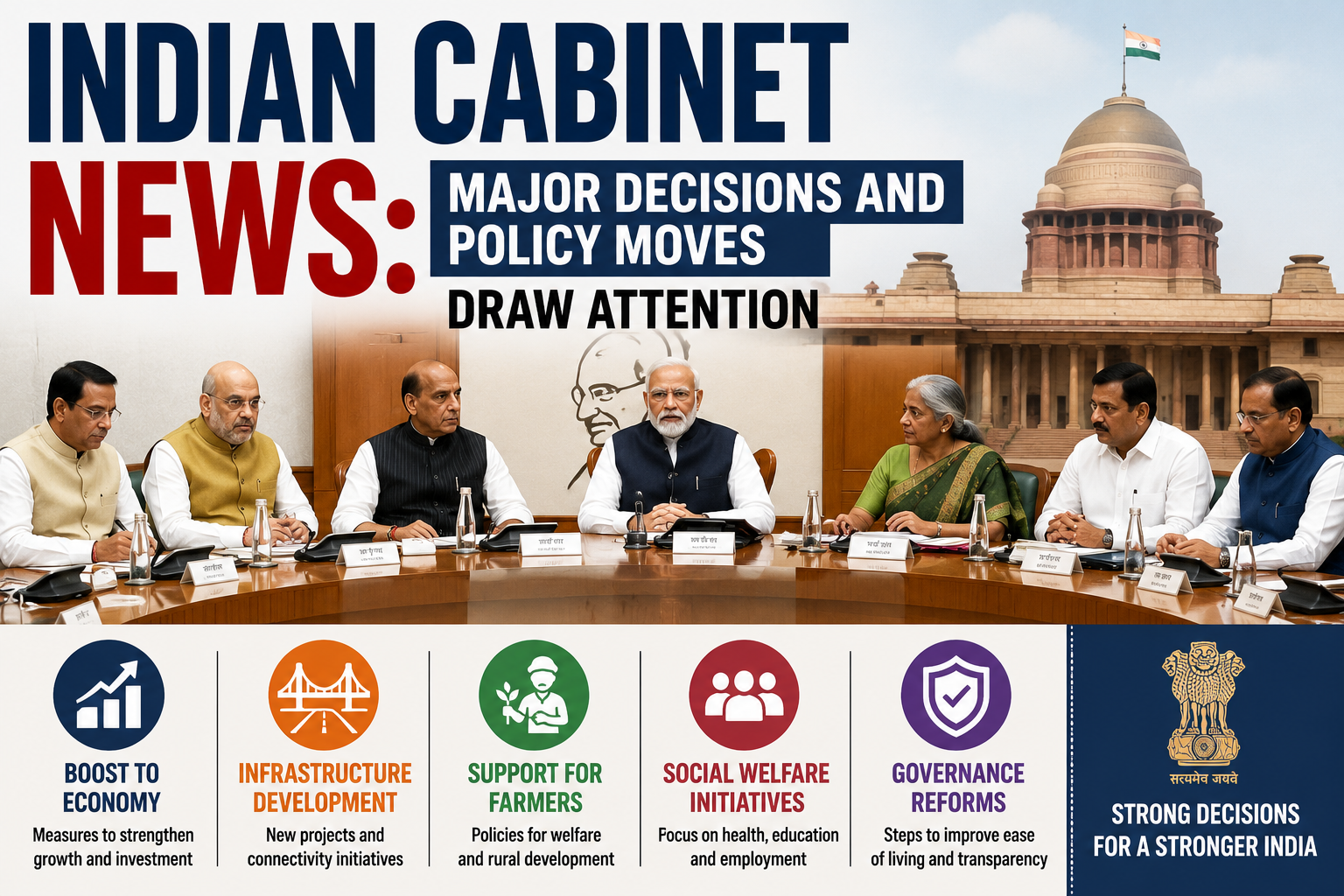
Indian Cabinet News Major Decisions and Policy Moves Draw Attention

Indian Cabinet News  Major Decisions and Policy Moves Draw Attention The Indian Cabinet and state cabinets continue to remain at the centre of major policy discussions, with several important decisions affecting infrastructure, energy, education and public welfare. Recent Union Cabinet decisions have included major investments in railway and highway connectivity, while the government is also focusing on long-term energy security. The Union Cabinet recently approved four railway multitracking projects covering eight districts across West Bengal, Odisha, Tamil Nadu and Andhra Pradesh. The projects are expected to add around 410 kilometres to the Indian Railways network and improve transportation capacity. Another major decision concerns the highway network. The Cabinet approved an upgrade of the Muzaffarpur-Sitamarhi-Sonbarsa section of NH-22 in Bihar to four lanes at a capital cost of about ₹3,590.73 crore. The project is expected to strengthen connectivity, including links toward the India-Nepal border. Energy security is also a major Cabinet priority. The government has approved the ₹84,084-crore Samudra Manthan programme for offshore oil and gas exploration, aimed at increasing domestic exploration and reducing dependence on imports. With infrastructure, energy and development remaining key priorities, Cabinet decisions are expected to continue influencing India's economic and social policy landscape.

Toxic Movie Review: Yash’s Comeback Gets Mixed Reactions

Toxic Movie Review: Yash’s Comeback Gets Mixed Reactions Yash’s much-awaited film Toxic: A Fairy Tale for Grown-Ups arrived in cinemas on August 26, 2026, creating huge excitement among Indian moviegoers. Directed by Geetu Mohandas, the gangster action drama features Yash alongside Nayanthara, Kiara Advani, Tara Sutaria, Huma Qureshi and Rukmini Vasanth. The biggest strength of Toxic is clearly Yash. His commanding screen presence, intense performance and larger-than-life action moments have received appreciation from many viewers. The film also stands out for its grand production design, cinematography and ambitious visual style. Some action sequences have been praised as genuine big-screen experiences. However, the movie has also received considerable criticism. Several reviewers have described the screenplay as confusing and uneven, while the lengthy runtime and rapid editing have made the viewing experience exhausting for some audiences. Critics have also pointed to underdeveloped supporting characters and an emotional storyline that does not always connect effectively. Early audience reactions are sharply divided, with fans celebrating Yash while others remain disappointed by the storytelling. Overall, Toxic appears to be a visually ambitious film that may appeal strongly to Yash fans but could leave viewers looking for a tighter and more coherent narrative.  

Hy-Tech Engineers IPO GMP: Grey Market Premium Signals Strong Investor Interest

Hy-Tech Engineers IPO GMP: Grey Market Premium Signals Strong Investor Interest The Hy-Tech Engineers IPO has become one of the major talking points in India's IPO market, with strong investor demand and a sharp rise in its grey market premium (GMP). The IPO opened for subscription on August 24 and closes today, August 27, 2026. The company has fixed a price band of ₹50–₹53 per share, while the issue size is approximately ₹135.73 crore. According to the latest available grey-market data, Hy-Tech Engineers' GMP has climbed to around ₹44 per share, equivalent to an indicative premium of about 83% over the upper issue price. At that level, the implied listing price would be close to ₹97. However, GMP is unofficial and can change quickly, so it should not be treated as a guaranteed listing price. Investor participation has also been exceptionally strong. Reports on the final day indicate that the issue was subscribed more than 50 times, reflecting substantial interest from investors. The IPO has a lot size of 283 shares, requiring ₹14,999 at the upper price band. Allotment is expected on August 28, with a tentative listing on BSE and NSE on September 1. Investors should consider the company's fundamentals, financial performance and risk factors rather than relying only on GMP before making an investment decision.