Explore six important MSME registrations in India, including Udyam, ZED, DPIIT, TReDS, IEC and GeM, with eligibility, costs and benefits.
Business & Finance
MSME India
Small businesses and entrepreneurs in India have several government registration and certification options that can help them improve their business operations, access procurement opportunities, explore export markets and become eligible for specific government support programmes.
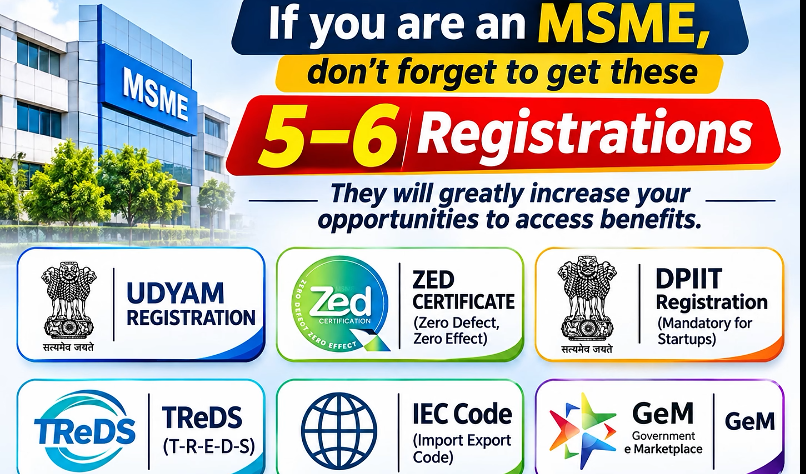
Six important names that MSME owners should understand are Udyam Registration, ZED Certification, DPIIT Startup Recognition, TReDS, Importer Exporter Code (IEC) and Government e-Marketplace (GeM).
However, these are not six compulsory registrations for every MSME. Each serves a different purpose, and eligibility depends on the nature, size and activities of the business.
Understanding the differences can help entrepreneurs avoid unnecessary applications, identify relevant opportunities and make better business decisions.
1. Udyam Registration – Official MSME recognition
Udyam Registration is the Government of India's official system for recognising eligible micro, small and medium enterprises.
It provides an enterprise with a permanent Udyam Registration Number and an electronic certificate. Businesses can use this recognition when applying for eligible MSME schemes, credit-related programmes, procurement opportunities and other government support.
MSME classification limits effective from April 1, 2025:
|
Category
|
Investment limit
|
Annual turnover limit
|
|
Micro
|
₹2.5 crore
|
₹10 crore
|
|
Small
|
₹25 crore
|
₹100 crore
|
|
Medium
|
₹125 crore
|
₹500 crore
|
Both investment and turnover criteria must be satisfied for the relevant category.
Important points:
-
Registration is free, online and paperless.
-
Aadhaar is required, with PAN and GST-linked information as applicable.
-
One enterprise should have one Udyam Registration.
-
There is no regular renewal requirement.
The government warns business owners against private websites and agents charging money for this free registration.
Udyam Registration Portal+1
2. ZED Certification – Improve quality and manufacturing standards
ZED stands for Zero Defect Zero Effect. It is a certification initiative under the Ministry of MSME designed to encourage businesses to improve product quality, manufacturing processes, workplace safety and environmental performance.
It is particularly relevant to manufacturing MSMEs that want to improve production standards and become more competitive.
The certification has three levels:
-
Bronze: Entry-level certification.
-
Silver: Higher-level assessment.
-
Gold: Advanced certification.
The scheme provides financial assistance towards certification costs. The Ministry's published scheme guidelines describe different subsidy rates for micro, small and medium enterprises, with additional support for certain eligible categories.
Who should consider it?
Manufacturers, engineering units, food-processing businesses, industrial suppliers and other eligible enterprises seeking quality improvements or better supplier credentials.
ZED is not compulsory for every MSME.
Government of India+1
3. DPIIT Startup Recognition – For eligible innovative businesses
Recognition application is free
DPIIT recognition is provided under the Startup India initiative by the Department for Promotion of Industry and Internal Trade.
It is intended for eligible businesses developing innovative products, services, processes or scalable business models with potential for employment generation or wealth creation.
Under the revised framework notified in February 2026, the general eligibility criteria include:
-
An eligible Indian-incorporated or registered entity, such as a private limited company, registered partnership, LLP or qualifying cooperative society.
-
Up to 10 years from incorporation or registration for a normal startup.
-
Turnover not exceeding ₹200 crore in any financial year since incorporation.
-
An innovation, improvement or scalable business model.
-
The entity must not have been formed by splitting up or reconstructing an existing business.
For recognised Deep Tech Startups, the age limit can extend to 20 years and the turnover limit to ₹300 crore, subject to the prescribed conditions.
Potential benefits include:
-
Access to eligible Startup India programmes.
-
Opportunities to participate in startup-focused initiatives.
-
Certain intellectual-property support facilities.
-
Access to specific tax benefits, subject to separate eligibility and approval requirements.
A normal trading or traditional business does not automatically qualify simply because it is registered as an MSME. A sole proprietorship is also not eligible for DPIIT startup recognition under the current framework.
Press Information Bureau+2
4. TReDS Registration – Get financing against unpaid invoices
RBI information: TReDS FAQs
Invoice financing platform
TReDS stands for Trade Receivables Discounting System. It is an electronic platform regulated by the Reserve Bank of India that helps eligible MSMEs obtain financing against approved invoices.
For example, suppose a small manufacturing company supplies products worth ₹10 lakh to a large corporate buyer, but payment is due after 60 days.
Instead of waiting for the entire payment period, the MSME can submit the eligible invoice through a TReDS platform. Banks and other permitted financiers can bid to finance the invoice. The business receives the financed amount after applicable discounting charges.
How it helps MSMEs:
-
Improves working capital availability.
-
Helps manage delayed customer payments.
-
Provides access to multiple financiers.
-
Can reduce dependence on conventional collateral-based borrowing.
Five operational platforms identified by the Ministry in its July 2026 announcement are:
-
-
-
-
-
An important development came in June 2026, when the government mandated operating Central Public Sector Enterprises to route settlement of invoices for goods and services procured from MSMEs through authorised TReDS platforms.
Important: TReDS is not a government grant or automatic loan approval. Financing depends on eligible invoices, buyer participation and financier decisions.
Frequently Asked Questions+1
5. IEC Code – For import and export businesses
IEC stands for Importer Exporter Code. It is issued by the Directorate General of Foreign Trade (DGFT), under the Ministry of Commerce and Industry.
Businesses generally need an IEC to import or export goods from India, unless they fall under a specified exemption.
It is relevant for:
-
Manufacturers exporting products.
-
-
Online businesses selling eligible products internationally.
-
Businesses sourcing machinery or raw materials from overseas markets.
Key information:
-
IEC is a 10-character code linked to the entity's PAN.
-
The application is submitted online through DGFT.
-
The prescribed application fee is ₹500.
-
IEC holders must complete the required annual electronic confirmation or updating during April–June, even if there are no changes.
For service exports, IEC requirements depend on the applicable Foreign Trade Policy provisions, including whether the exporter is claiming benefits under the policy.
An IEC alone does not provide an export licence for restricted goods or remove other product-specific regulatory requirements.
DGFT Content+2
6. GeM Registration – Sell products and services to government buyers
Seller registration is free
The Government e-Marketplace, commonly known as GeM, is an online procurement platform used by government departments, ministries, public sector organisations and other authorised buyers.
MSMEs can register as sellers and list eligible products or services for government procurement.
Business opportunities include:
-
Office equipment and furniture.
-
Computers and electronic products.
-
Stationery and printing services.
-
Cleaning and maintenance services.
-
-
Professional and technical services.
How to get started:
-
Visit the official GeM website.
-
-
Complete the required identity and business verification.
-
Add business, bank and other profile details.
-
List eligible products or services in the catalogue.
-
Explore relevant bids and procurement opportunities.
GeM's published seller registration guide confirms that registration is free. However, sellers should check the current terms for applicable transaction-related or other charges, where relevant.
Registration does not guarantee a government purchase order. Sellers must satisfy the conditions of individual bids and procurement requirements.
Quick comparison: Which registration does your business need?
|
Registration
|
Main purpose
|
Cost information
|
|
Udyam
|
MSME recognition
|
Free
|
|
ZED
|
Quality and manufacturing improvement
|
Certification charges; subsidy available
|
|
DPIIT
|
Startup recognition
|
Free
|
|
TReDS
|
Invoice financing
|
Platform and financing terms apply
|
|
IEC
|
Import and export
|
₹500 application fee
|
|
GeM
|
Government procurement
|
Seller registration free
|
Important: These six registrations are not compulsory for every business
Choose registrations according to your business activities.
-
Small shop or service business: Consider Udyam if eligible.
-
Manufacturing unit: Udyam and potentially ZED.
-
Innovative technology startup: Explore Udyam and DPIIT recognition, if eligible.
-
MSME supplying large companies: Explore Udyam and TReDS.
-
Import/export business: Check IEC requirements.
-
Business targeting government contracts: Explore GeM.
Official government registration link
DPIIT Startup Recognition
Beware of fake registration websites: Apply through official government portals. Do not share OTPs, passwords or sensitive business documents with unauthorised agents.
By News National Editorial Team
Source transparency:
Information has been checked against the Ministry of MSME, Startup India, DPIIT, RBI, DGFT, Government e-Marketplace and Press Information Bureau publications. Rules, fees and scheme availability can change; verify the latest conditions before applying.